Last updated: November 23, 2026
A small woodworking shop runs on square footage, and a floor-standing dust collector eats the space a second bench or a lumber rack could use. Hanging the collector on the wall solves that problem directly, but it creates a new one: the unit has to earn its place on a wall that also holds tools, clamps, and lumber. The decision is about balance, because the strongest wall unit may be too heavy for the studs, and the lightest one may not keep up with the planer.
This guide is for owners of compact shops, from a single-car garage to a basement room with two or three machines. Each collector below was chosen from its Amazon title and listed specifications, so the airflow, motor size, bag capacity, filtration, and weight figures come from the product page itself, and every pick is judged on how it behaves in tight quarters.
Quick Picks
As an Amazon Associate we earn from qualifying purchases
| Product | Best for | Key spec from title |
|---|---|---|
| Shop Fox W1826 | A permanent wall station in a cramped shop | 1 HP motor, 537 CFM, 2.5-micron filtration |
| POWERTEC DC5371 | Fine dust control in a small enclosed shop | 1 HP motor, 560 CFM, 1-micron filter bag |
| VEVOR DC100M | A small shop that works long hours | 1 HP motor, 560 CFM, 21-gallon collection bag |
| WEN DC3401 | The lightest install in a tight garage | 5.7-amp motor, 660 CFM, 12-gallon bag |
| WEN DC3474 | A small shop ready for a quieter motor | 7.4-amp induction motor, 15-gallon bag |
How to Choose
Measure the wall before you measure the airflow
Small shops fail on installation more often than on suction, so start with the wall itself. Check the stud spacing, the free height, and what already hangs there, because a collector needs a clear vertical run for the bag to hang and the zipper to open. A 21-gallon bag is tall, and a heavy fixed unit needs studs that line up with its bracket. Measure twice, then compare the dimensions on the listing, including the unit with the bag attached rather than the bare motor housing.
Treat every square foot of hose as lost suction
In a small shop the hose run is short, which is an advantage, but only if you keep it that way. A collector mounted beside the table saw with a three-foot hose performs far better than the same unit mounted across the room with a sagging ten-foot run. Plan the mount so the hose drops straight to the machine you use most, and use a wye fitting with blast gates if a second machine shares the collector. Short, straight hose runs are the cheapest airflow upgrade a small shop can buy.
Match the bag to the shop’s rhythm, not the catalogue
Bag capacity decides how often work stops, and in a small shop every stop means moving something to reach the trash. A 12-gallon bag is fine for a shop that saws occasionally, but a shop that planes boards daily will empty it constantly. A 21-gallon bag stretches the interval, while a 15-gallon bag splits the difference. Also weigh the emptying method: a bottom zipper and a clear window turn a chore into a two-minute job, which matters when the trash can sits outside the shop.
Fine dust matters more when the room is small
A small room concentrates fine dust faster than a large one, so the micron rating deserves more weight here than in a big open shop. A 5-micron bag leaves fine sanding dust in the air, which settles on tools, lumber, and lungs in a confined space. A 2.5-micron bag is a reasonable middle ground, and a 1-micron bag is the strongest choice for a basement or a garage with the door closed. Finer bags clog sooner, so budget a minute to brush the bag clean after sanding sessions.
The 5 Best Options
Shop Fox W1826

The Shop Fox W1826 is built for the small shop that wants a collector bolted in place and forgotten. Its 1 HP induction motor moves 537 CFM through a 4-inch intake, enough for a table saw, a bandsaw, or a router table running alone. The 2.5-micron cloth bag filters finer than most budget wall units, and the clear window on the lower bag shows the dust level without opening anything. The bracket locks to the wall with a screw, so the unit lifts off for cleaning and drops back on without tools, which matters when the shop has no spare bench to set it on.
Specs
- 1 HP induction motor
- Air suction capacity of 537 CFM
- 2.5-micron cloth filter bag
- 4-inch intake hole
- Collection capacity of 2 cubic feet
- Static pressure of 7.2 inches
- Dual voltage 110V or 220V single-phase
- Wall mounting bracket with locking screw
Best for: A small shop that wants a permanent wall station beside its main machine.
Watch out for: The unit plus a full bag weighs over 50 pounds, so confirm the bracket lines up with your studs and use lag screws, not drywall anchors.
POWERTEC DC5371

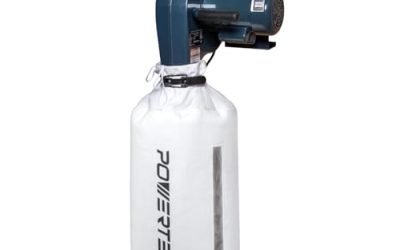
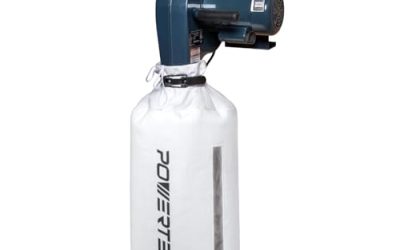
The POWERTEC DC5371 earns its place in a small enclosed shop through filtration, not brute airflow. Its 1-micron reusable filter bag captures the fine particles that sanders and MDF cutting release, which is the dust that lingers longest in a confined room. The 1 HP induction motor delivers 560 CFM through a 4-inch inlet with a grate guarding the impeller, and the dual-voltage motor runs on 120V or 240V. A window in the bag shows the fill level, and a bottom zipper empties it without removing the unit from the wall, a real benefit when floor space is scarce.
Specs
- 1 HP induction motor, dual voltage 120V or 240V
- Air suction capacity of 560 CFM
- 1-micron reusable filter bag with viewing window
- Motor speed of 3450 RPM
- 4-inch inlet with built-in grate
- 12 amps at 120V, 6 amps at 240V
- Mounting bracket and hardware included
- Bottom zipper for dust disposal
Best for: A small enclosed shop where fine dust control matters more than maximum airflow.
Watch out for: The 1-micron bag clogs faster than a coarser bag, so brush it clean after heavy sanding or the suction will fade.
VEVOR DC100M

The VEVOR DC100M is the small-shop pick for long work sessions, because its 21-gallon non-woven collection bag holds nearly twice what compact collectors carry. The 1 HP induction motor moves 560 CFM, and the 2.5-micron bag handles fine sanding dust while the transparent window and bottom zipper keep the emptying routine simple. At about 24 pounds it is light for its capacity, which makes hanging it on a stud wall a one-person job. In a shop where every trip to the trash means stepping over lumber, the big bag is a genuine workflow improvement.
Specs
- 1 HP induction motor
- Air suction capacity of 560 CFM
- 21-gallon (80 L) non-woven collection bag
- 2.5-micron filter bag
- Noise level of 90 dB or less
- Voltage of 120 volts, 60 Hz
- Dimensions with bag of 40.94 by 13.78 by 15.75 inches
- Weight of 24.03 pounds
Best for: A small shop that runs long sessions and wants the fewest interruptions to empty the bag.
Watch out for: The tall bag needs vertical clearance, so measure the wall height and leave room below for the zipper to open fully.
WEN DC3401

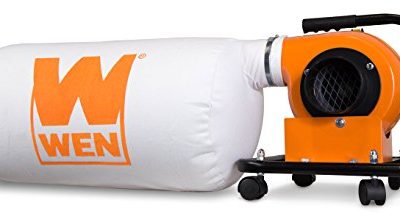
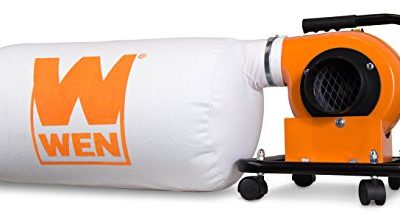
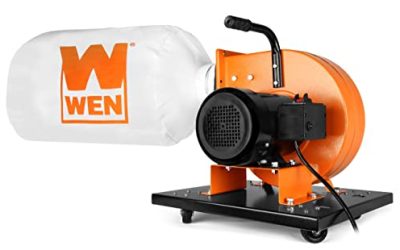
The WEN DC3401 is the lightest install in this group and the strongest on airflow, a combination that suits a shop where the wall space is tight and the saw is hungry. Its 660 CFM airflow handles a table saw or a small jointer through a short hose, and the optional wall mount lets you hang it high while the included mobile base keeps the rolling option open. At about 17 pounds, one person can lift it onto the bracket alone, and the 12-gallon zippered bag empties quickly. It is the pick when the shop rearranges often and the collector has to keep up.
Specs
- 5.7-amp motor with 6-inch impeller
- Airflow up to 660 CFM
- 12-gallon collection bag with zipper
- 5-micron filter bag
- Optional wall mount and mobile base included
- 4-inch dust port
- Weighs about 17 pounds
Best for: A small shop that rearranges often and needs the lightest, strongest-airflow wall option.
Watch out for: The 5-micron bag passes fine sanding dust, so pair it with a respirator or an air cleaner if you sand indoors.
WEN DC3474

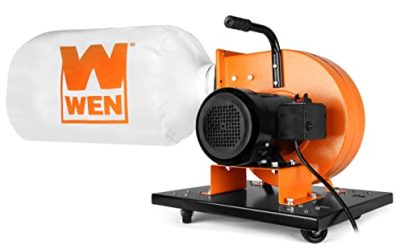
The WEN DC3474 is the quieter step up for a small shop that has settled into a routine and wants a smoother-running machine. Its 7.4-amp induction motor moves up to 600 CFM, and the 15-gallon bag sits between the compact 12-gallon units and the largest bags here, so emptying happens less often without the tall profile of a 21-gallon bag. The optional wall mount and the mobile base both come in the box, and the onboard carrying handle makes it easy to shift around the shop. It suits a small shop where the collector runs for hours at a time.
Specs
- 7.4-amp induction motor with 9-inch impeller
- Airflow up to 600 CFM
- 15-gallon 5-micron zippered collection bag
- 4-inch dust port
- Optional wall mount and mobile base included
- Onboard carrying handle
- Swivel casters on the mobile base
Best for: A small shop that wants a quieter induction motor and a mid-size bag without a tall wall profile.
Watch out for: The 5-micron bag is coarse for heavy sanding in a closed shop, so consider a finer replacement bag if fine dust becomes a problem.
Which One Fits Your Situation
Your shop is a one-car garage and the saw never moves
Hang the Shop Fox W1826 beside the saw as a permanent station. Its 2.5-micron bag filters finer than budget units, and the locking bracket lets the unit lift off for cleaning. Just confirm the stud spacing matches the bracket, because a fixed unit is only as good as its mount.
You sand a lot and the door stays closed in winter
Choose the POWERTEC DC5371 for its 1-micron bag, the finest filtration here. In a small enclosed room, fine dust concentrates fast, and this bag is the strongest answer. Brush it clean after sanding sessions so the fine pores stay open and the suction holds. Brush the bag clean after sanding so the fine pores stay open and suction holds.
You work long hours and the trash run is a hassle
Take the VEVOR DC100M and its 21-gallon bag, which nearly doubles the time between emptying compared with compact units. The window shows the level at a glance, and the bottom zipper empties it without taking the unit down. Measure the wall height first for the tall bag. The window shows the level at a glance, and the zipper empties it cleanly.
You rearrange the shop every few months
Pick the WEN DC3401, the lightest unit here at about 17 pounds, with a wall mount and a rolling base both in the box. Its 660 CFM is the strongest airflow in the group, so it keeps up with the saw wherever it ends up. The 12-gallon bag is small, but the flexibility is worth it.
Common Mistakes
- Hanging the collector across the room from the main machine, which wastes suction on a long, sagging hose.
- Mounting on drywall anchors instead of lag screws into studs, which risks the unit pulling free under a full bag.
- Leaving every blast gate open, so no single machine gets enough suction.
- Choosing a 5-micron bag for a small enclosed shop, where fine dust concentrates and settles on everything.
- Forgetting the vertical space the bag needs, which turns emptying the zipper into a wrestling match against the wall.
Frequently Asked Questions
How much wall space does a wall mounted dust collector need?
Most units need a stud-width bracket plus vertical clearance for the bag to hang free and the zipper to open. The VEVOR DC100M is the tallest here at about 41 inches with the bag attached, while the compact WEN DC3401 is shorter. Measure the wall height and the space below the bracket before ordering, and leave room to drop the bag.
Can a wall mounted collector handle a thickness planer?
A planer produces a high volume of shavings, so it needs strong airflow and a large bag. The WEN DC3401 at 660 CFM and the WEN DC3474 at 600 CFM are the best matches here, and the VEVOR DC100M adds the largest bag. Keep the hose short and empty the bag before it packs solid.
Is a 1 HP collector enough for a small shop?
Yes, for a small shop running one machine at a time. Every collector here is 1 HP class except the WEN models, which are rated in amps, and all move 537 to 660 CFM. That covers a table saw, a bandsaw, a router table, or a sander used alone. Two machines running at once would need a larger central system.
How do I keep suction strong in a small shop?
Keep the hose short and straight, close every blast gate except the one in use, and empty the bag before it reaches two-thirds full. Brush a fine filter bag clean after heavy sanding, because a clogged bag cuts airflow faster than a long hose does. A short run to a single machine is the strongest setup.