Last updated: November 23, 2026
A wall mounted dust collector changes the whole layout of a small shop. Instead of wheeling a floor unit around saws and benches, you bolt the collector to a stud wall, run a short hose to the machine you use most, and get the floor back. The real decision is not whether to mount on the wall but which trade-off to accept: higher airflow usually means a coarser bag, while the finest filtration often comes with a smaller motor and a heavier unit to hang.
This guide is for garage woodworkers, basement hobbyists, and anyone whose shop shares space with a car, a laundry area, or a storage wall. Every collector below was chosen from its Amazon title and listed specifications, so the airflow, motor size, bag capacity, and filtration numbers come straight from the product page rather than from a roundup elsewhere.
Quick Picks
As an Amazon Associate we earn from qualifying purchases
| Product | Best for | Key spec from title |
|---|---|---|
| WEN DC3401 | A first wall mount in a one-car garage shop | 5.7-amp motor, 660 CFM, 12-gallon bag |
| Shop Fox W1826 | A fixed station beside a table saw or jointer | 1 HP motor, 537 CFM, 2.5-micron filtration |
| POWERTEC DC5371 | Fine sanding dust in a small enclosed shop | 1 HP motor, 560 CFM, 1-micron filter bag |
| BUCKTOOL DC30A-1 | A collector mounted above easy reach | 1 HP motor, 550 CFM, remote control included |
| VEVOR DC100M | Long sessions between bag emptying | 1 HP motor, 560 CFM, 21-gallon collection bag |
How to Choose
Match airflow to the hungriest tool on the wall
Airflow, measured in CFM, decides whether chips actually reach the bag or stall in the hose. A benchtop sander or a small bandsaw runs happily on a 537 CFM collector, while a thickness planer throwing wide shavings needs the 660 CFM class to keep up. Check the dust port on your main machine first: a 4-inch port pairs with every unit here, but a tool with a 2.5-inch port needs a reducer, and that reducer costs airflow. If you plan to serve two machines through a wye fitting, buy more CFM than a single-tool setup would need, because splitting the hose divides the suction.
Read the micron rating before you breathe the air
The micron rating on the filter bag tells you which dust escapes back into the room. A 5-micron bag catches visible chips and coarse sanding dust, which suits a shop with open doors and a separate air cleaner. A 2.5-micron bag traps much finer particles from orbital sanders, and a 1-micron bag goes further still for enclosed garages where fine dust hangs in the air. Finer bags clog sooner, so expect to shake or brush the bag more often. Weigh this against your shop: a shared garage with a family car parked nearby deserves finer filtration than a detached shed.
Weigh the unit before you drill the bracket
Wall mounted does not mean weightless, and the bracket is only as strong as the studs behind it. The lightest collector here is around 17 pounds, while the heaviest approaches 50 pounds with a full bag, so the mounting job is completely different. Measure the wall space, confirm the stud spacing, and check the bracket hole pattern against your studs before ordering. A unit that must hang beside a table saw also needs clearance below it for the bag to hang free and for you to reach the zipper. Leave room to drop the bag without moving the saw.
Count the real cost of emptying the bag
Bag capacity decides how often you stop work to empty dust, and the emptying method decides how messy that stop becomes. A 12-gallon bag fills fast under a planer, while a 21-gallon bag stretches a sanding session considerably longer. Look for a bottom zipper and a clear window on the bag, both of which make the chore quicker and cleaner. Also check whether the listing includes spare bags or a standard size you can reorder easily. A collector with an odd bag size can leave you hunting for replacements when the original tears.
The 5 Best Options
WEN DC3401

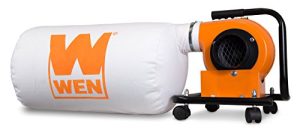
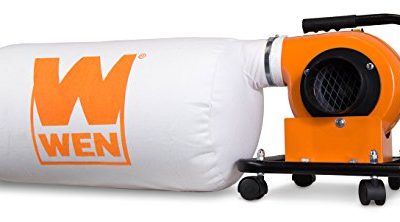
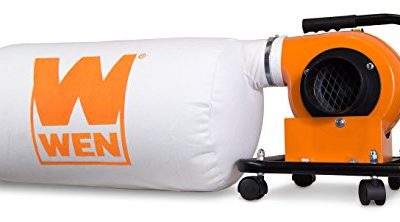
The WEN DC3401 suits a woodworker setting up a first dust collection point without giving up floor space. Its 660 CFM airflow handles a table saw, a jointer, or a miter saw through a short hose, and the optional wall mount lets you hang it high and keep the bench area clear. The 12-gallon zippered bag is easy to detach, and the whole unit weighs little enough that one person can lift it onto the bracket. It works as a rolling collector too, so a shop that rearranges often is not locked into the wall position.
Specs
- 5.7-amp motor with 6-inch impeller
- Airflow up to 660 CFM
- 12-gallon collection bag with zipper
- 5-micron filter bag
- Optional wall mount and mobile base included
- 4-inch dust port
- Weighs about 17 pounds
Best for: A first wall mounted collector in a garage shop that serves one machine at a time.
Watch out for: The 5-micron bag passes fine sanding dust, so pair it with a respirator or an air cleaner if you sand a lot indoors.
Shop Fox W1826

The Shop Fox W1826 is the fixed-installation choice for a shop that already knows where its main machine lives. Its 1 HP induction motor moves 537 CFM through a 4-inch intake, enough for a table saw, a bandsaw, or a router table running alone. The 2.5-micron cloth bag filters finer than most budget wall units, and the clear window on the lower bag shows the dust level without opening anything. The bracket locks onto the wall with a screw, so the unit lifts off for cleaning and drops back on without tools.
Specs
- 1 HP induction motor
- Air suction capacity of 537 CFM
- 2.5-micron cloth filter bag
- 4-inch intake hole
- Collection capacity of 2 cubic feet
- Static pressure of 7.2 inches
- Dual voltage 110V or 220V single-phase
- Wall mounting bracket with locking screw
Best for: A dedicated wall station beside one stationary machine in a small shop.
Watch out for: Confirm your wall has studs spaced to match the bracket, and plan for the unit plus a full bag weighing over 50 pounds.
POWERTEC DC5371

The POWERTEC DC5371 is the pick when fine dust, not just chips, is the problem. Its 1-micron reusable filter bag captures the fine particles that orbital sanders and MDF cutting throw into the air, which matters in a closed garage or a basement shop. The 1 HP induction motor delivers 560 CFM through a 4-inch inlet with a built-in grate guarding the impeller, and the dual-voltage motor runs on 120V or 240V. A window in the bag shows the fill level, and a zipper at the bottom empties it without removing the bag.
Specs
- 1 HP induction motor, dual voltage 120V or 240V
- Air suction capacity of 560 CFM
- 1-micron reusable filter bag with viewing window
- Motor speed of 3450 RPM
- 4-inch inlet with built-in grate
- 12 amps at 120V, 6 amps at 240V
- Mounting bracket and hardware included
- Bottom zipper for dust disposal
Best for: Enclosed shops where fine sanding dust needs the finest bag in this lineup.
Watch out for: The 1-micron bag clogs faster than a coarser bag, so check it after heavy sanding sessions and brush it clean before airflow drops.
BUCKTOOL DC30A-1

The BUCKTOOL DC30A-1 solves the annoyance of a wall mounted switch you cannot reach. A remote control starts and stops the collector from across the shop, which matters when the unit hangs above a bench or behind a machine. The 1 HP totally enclosed fan-cooled induction motor moves 550 CFM, and the 2-micron dust bag handles fine sanding dust better than a 5-micron bag. It also rolls on braked wheels, so the same unit can hang on the wall for a fixed station or roll to a second machine when the layout changes.
Specs
- 1 HP TEFC induction motor, 6.5 amps
- Airflow of 550 CFM
- 2-micron dust filter bag
- Remote control included
- 4-inch by 80-inch hose included
- Wall mount bracket and wheels with brake
- 9-inch balanced steel radial fin impeller
- Maximum static pressure of 5.8 inches of water
Best for: A collector hung high on the wall where the power switch would otherwise be a stretch.
Watch out for: Check that the remote works reliably from your normal working position before you finalize the mounting spot, and keep a spare battery on hand.
VEVOR DC100M

The VEVOR DC100M is the choice when emptying the bag interrupts work too often. Its 21-gallon non-woven collection bag holds far more than the 12-gallon and 15-gallon bags on the smaller units here, so a long sanding or sawing session runs without a pause. The 1 HP induction motor moves 560 CFM, and the 2.5-micron bag catches fine dust while the transparent window and bottom zipper make checking and emptying simple. At about 24 pounds it is light for its capacity, which makes the wall installation easier than heavier fixed units.
Specs
- 1 HP induction motor
- Air suction capacity of 560 CFM
- 21-gallon (80 L) non-woven collection bag
- 2.5-micron filter bag
- Noise level of 90 dB or less
- Voltage of 120 volts, 60 Hz
- Dimensions with bag of 40.94 by 13.78 by 15.75 inches
- Weight of 24.03 pounds
Best for: Long work sessions in a fixed wall spot where a large bag means fewer interruptions.
Watch out for: The unit is tall with the bag attached, so measure the wall height and leave clearance below for the zipper to open fully.
Which One Fits Your Situation
Your shop is a single-car garage with one main saw
Hang the WEN DC3401 beside the table saw and run a short hose straight to the port. Its 660 CFM is the strongest airflow here, and the light weight makes a one-person install realistic. The 12-gallon bag is small, but a single saw fills it slowly enough, and the zipper empties it in minutes.
You sand indoors and worry about the fine dust you cannot see
Choose the POWERTEC DC5371 for its 1-micron bag, the finest filtration in this group. It traps the particles an orbital sander throws up, which matters when the shop shares air with the rest of the house. Just remember to brush the bag clean regularly so the fine pores stay open.
The collector has to hang above a bench, out of easy reach
Pick the BUCKTOOL DC30A-1, because its remote control removes the daily reach for the switch. Mount it high, keep the hose short, and start or stop the motor from wherever you stand. The braked wheels also let you drop it to the floor for cleaning. Mount it high, keep the hose short, and start or stop the motor from wherever you stand.
You want the fewest trips to the trash can
Take the VEVOR DC100M and its 21-gallon bag, which holds nearly twice what the compact units carry. It suits a fixed station where the collector stays put for weeks, and the window shows the level at a glance. Measure the wall height first, since the tall bag needs room below.
Common Mistakes
- Mounting the collector on drywall anchors instead of lag screws driven into studs, which risks the unit pulling free once the bag fills.
- Running a long, sagging hose across the shop, which bleeds airflow before dust ever reaches the collector.
- Leaving every blast gate open on a multi-machine run, so suction splits and no single tool gets enough pull.
- Choosing a 5-micron bag for heavy MDF sanding in a closed room, then wondering why fine dust still coats everything.
- Forgetting to leave clearance under the bag, which makes emptying the zipper a two-person job against the wall.
Frequently Asked Questions
Can a wall mounted dust collector serve more than one machine?
Yes, with a wye fitting and blast gates, but only one gate should stay open at a time. Wall mounted collectors in this class are sized for single-tool use, so opening two gates divides the airflow and weakens pickup at both machines. Close the unused gates and keep hose runs short for the best result.
How fine should the filter bag be for a home shop?
A 2.5-micron bag suits most home shops, catching fine sanding dust while resisting clogs better than a 1-micron bag. Choose a 1-micron bag if the shop is enclosed or shares air with living space, and accept more frequent cleaning. A 5-micron bag works only where visible chips are the main concern.
Do I need an electrician to install one of these collectors?
Most models here run on a standard 120V household circuit, so no electrician is needed for the basic setup. The dual-voltage models can also run on 240V if your shop already has that circuit, but switching voltage means rewiring the motor, which is a job for someone comfortable with electrical work.
How often should I empty the collection bag?
Empty the bag when it reaches about two-thirds full, because a packed bag restricts airflow and strains the motor. A planer fills a 12-gallon bag in a single long session, while sanding takes much longer. The clear window on several models here lets you check the level without opening the bag.