Last updated: November 23, 2026
A home workshop is usually a shared space, whether that means a garage that still parks a car, a basement beside the laundry, or a spare room the family walks past. That shared reality shapes the dust collector decision more than any spec sheet does. The unit has to hang on the wall without taking over the room, run without rattling the house, and keep fine dust from drifting into the hallway. Picking well means the workshop stays welcome in the home instead of becoming a source of friction.
This guide is for home woodworkers whose shops live inside or beside the house, with a table saw or a sander and a family nearby. The four collectors below were chosen from their Amazon titles and listed specifications, so the motor, airflow, bag size, filtration, and noise figures come from the product page itself.
Quick Picks
As an Amazon Associate we earn from qualifying purchases
| Product | Best for | Key spec from title |
|---|---|---|
| WEN DC3474 | A home shop that runs for hours at a time | 7.4-amp induction motor, 15-gallon bag |
| BUCKTOOL DC30A-1 | A collector hung above a workbench | 1 HP motor, 550 CFM, remote control included |
| WEN DC3401 | A home garage that still parks a car | 5.7-amp motor, 660 CFM, 12-gallon bag |
| VEVOR DC100M | A home shop with long weekend sessions | 1 HP motor, 560 CFM, 21-gallon collection bag |
How to Choose
Think about the people beyond the workshop door
A home workshop shares air, walls, and sometimes a ceiling with the rest of the house, so the collector has to serve the household as well as the woodworker. Fine dust that escapes a coarse bag drifts into living space, and a loud motor carries through a floor. Prioritize filtration first: a 2.5-micron or 1-micron bag is a better default at home than a 5-micron bag. Then consider the motor type, because an induction motor generally runs smoother and quieter than a brushed motor over a long session.
Keep the car, the laundry, and the lumber in mind
Home workshops rarely have a dedicated wall, so the collector competes with storage, a workbench, and the family car. Measure the free wall carefully, including what hangs below the bracket, because the bag needs room to hang and the zipper needs room to open. A light unit that one person can lift onto a bracket is a practical advantage when the shop is also a garage. If the car parks beside the bench, a wall mounted unit is the right call, since it leaves the floor clear for parking.
Choose a motor that fits a household circuit
Most home workshops run on standard household circuits, so the collector should plug in and work without electrical changes. Every model here runs on 120V, and two offer dual-voltage operation for shops that already have a 240V circuit. Avoid the temptation to rewire for a marginal gain; the difference between 537 CFM and 660 CFM matters less at home than a simple, reliable plug-in setup. Check the amp draw on the listing against the circuit that also feeds the saw, since a shared circuit can trip under load.
Plan the emptying routine around the house
Emptying a dust bag in a home workshop means carrying dust past living space, so the routine should be quick, clean, and infrequent. A large bag means fewer trips, and a bottom zipper means the dust falls straight into a trash bag instead of puffing into the room. A clear window shows the level before the bag overflows. If the trash cans sit outside, a 21-gallon bag is worth more at home than in a detached shop, because every emptying trip crosses the house.
The 4 Best Options
WEN DC3474

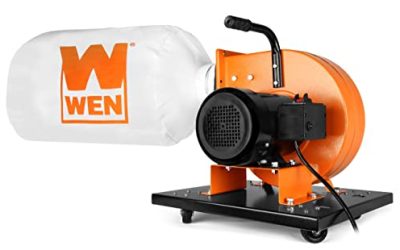
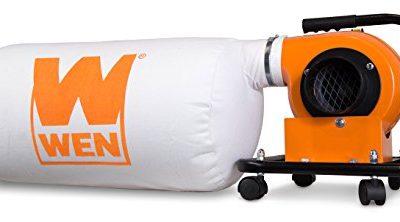
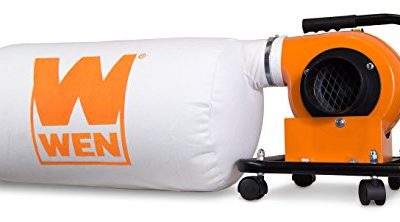
The WEN DC3474 suits a home workshop where the collector runs for hours and the house is just beyond the door. Its 7.4-amp induction motor runs smoother than a brushed motor and moves up to 600 CFM, while the 15-gallon bag holds more than compact units without the tall profile of a 21-gallon bag. The optional wall mount and the mobile base both come in the box, so the unit can hang beside the saw or roll out of the way when the car comes home. The onboard carrying handle makes moving it between positions easy.
Specs
- 7.4-amp induction motor with 9-inch impeller
- Airflow up to 600 CFM
- 15-gallon 5-micron zippered collection bag
- 4-inch dust port
- Optional wall mount and mobile base included
- Onboard carrying handle
- Swivel casters on the mobile base
Best for: A home workshop where the collector runs long sessions and the family is nearby.
Watch out for: The 5-micron bag is coarse for heavy sanding indoors, so consider a finer replacement bag if fine dust drifts into the house.
BUCKTOOL DC30A-1

The BUCKTOOL DC30A-1 fits a home workshop where the collector hangs above a bench and the switch is a stretch. Its remote control starts and stops the motor from anywhere in the room, which means the collector can live high on the wall, out of the way of the car and the bench. The 1 HP totally enclosed fan-cooled induction motor moves 550 CFM, and the 2-micron bag traps fine sanding dust better than a 5-micron bag. It also rolls on braked wheels, so the same unit can hang on the wall or roll to a second machine when the layout changes.
Specs
- 1 HP TEFC induction motor, 6.5 amps
- Airflow of 550 CFM
- 2-micron dust filter bag
- Remote control included
- 4-inch by 80-inch hose included
- Wall mount bracket and wheels with brake
- 9-inch balanced steel radial fin impeller
- Maximum static pressure of 5.8 inches of water
Best for: A home workshop where the collector hangs high above a bench, out of easy reach.
Watch out for: The 80-inch hose limits how far the collector can sit from the machine, so plan the mount close to the main saw.
WEN DC3401

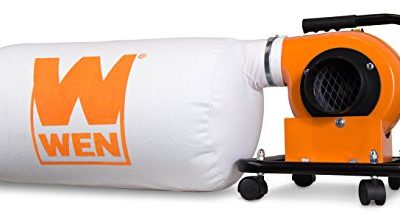
The WEN DC3401 is the home garage pick when floor space is the scarcest resource. Its 660 CFM airflow is the strongest in this group, handling a table saw or a small jointer through a short hose, and at about 17 pounds it is the lightest unit here, so one person can lift it onto the bracket alone. The optional wall mount keeps the floor clear for parking, while the included mobile base offers a rolling option if the shop rearranges. The 12-gallon zippered bag empties quickly, which suits a shop that works in shorter bursts between household duties.
Specs
- 5.7-amp motor with 6-inch impeller
- Airflow up to 660 CFM
- 12-gallon collection bag with zipper
- 5-micron filter bag
- Optional wall mount and mobile base included
- 4-inch dust port
- Weighs about 17 pounds
Best for: A home garage that still parks a car and needs the floor kept clear.
Watch out for: The 5-micron bag lets fine sanding dust through, so wear a respirator when sanding and keep the garage door open when possible.
VEVOR DC100M

The VEVOR DC100M is the home workshop pick for long weekend sessions, because its 21-gallon non-woven collection bag holds nearly twice what compact collectors carry. The 1 HP induction motor moves 560 CFM, the 2.5-micron bag handles fine dust, and the transparent window plus bottom zipper make checking and emptying straightforward. At about 24 pounds it is light for its capacity, which makes the wall installation a one-person job. Fewer trips to the outdoor trash can is a real benefit when every emptying run crosses the house.
Specs
- 1 HP induction motor
- Air suction capacity of 560 CFM
- 21-gallon (80 L) non-woven collection bag
- 2.5-micron filter bag
- Noise level of 90 dB or less
- Voltage of 120 volts, 60 Hz
- Dimensions with bag of 40.94 by 13.78 by 15.75 inches
- Weight of 24.03 pounds
Best for: A home workshop with long weekend sessions and the fewest possible trips to empty the bag.
Watch out for: The tall bag needs vertical wall clearance, and the listed noise level reaches 90 dB, so ear protection is sensible in a small room.
Which One Fits Your Situation
The workshop shares a wall with the living room
Choose the WEN DC3474 for its smooth-running induction motor and 600 CFM airflow. It runs for long sessions without the harsh character of a brushed motor, and the 15-gallon bag means fewer interruptions. The wall mount or rolling base lets the unit move out of the way when the room needs to serve the household.
The collector has to hang above the bench, out of reach
Pick the BUCKTOOL DC30A-1, because the remote control removes the daily stretch for the switch. Mount it high, keep the hose short, and start or stop it from wherever you stand. The 2-micron bag is also a genuine filtration step up for a home shop. The 2-micron bag also traps fine sanding dust better than a budget 5-micron bag.
The garage still parks a car every night
Hang the WEN DC3401 on the wall and keep the floor clear. At about 17 pounds it is the lightest install here, and its 660 CFM is the strongest airflow in the group. The 12-gallon bag is small, but the floor space it saves is worth more in a shared garage.
You work long weekends and hate carrying dust through the house
Take the VEVOR DC100M and its 21-gallon bag, which nearly doubles the time between emptying compared with compact units. The window shows the level at a glance, and the bottom zipper drops dust straight into a trash bag. Measure the wall height first for the tall bag. The window shows the level at a glance, and the bottom zipper empties it cleanly.
Common Mistakes
- Hanging the collector on drywall anchors instead of lag screws into studs, which risks the unit pulling free under a full bag.
- Choosing a 5-micron bag for a shop that shares air with the house, where fine dust drifts into living space.
- Running the saw and the collector on the same household circuit without checking the combined amp draw.
- Mounting the collector far from the main machine, which wastes suction on a long hose run.
- Forgetting ear protection in a small room, where even a modest collector sounds louder than it would in a large shop.
Frequently Asked Questions
Will a wall mounted dust collector keep dust out of the house?
It helps a great deal, but it is not a complete seal. A fine filter bag, 2.5-micron or 1-micron, captures the particles that would otherwise drift through doorways, and a short hose keeps suction strong at the tool. Keep the workshop door closed during dusty work, wear a respirator for sanding, and consider a room air cleaner as a second layer.
How loud are these collectors in a home workshop?
Most wall mounted collectors in this class run loud enough that ear protection is sensible in a small room. The VEVOR DC100M lists a noise level of 90 dB or less, and induction-motor models like the WEN DC3474 and BUCKTOOL DC30A-1 generally run smoother than brushed-motor units. Close the workshop door and wear hearing protection for long sessions.
Can I install a wall mounted collector myself?
Yes, with basic tools. Find the studs, drive lag screws through the mounting bracket, and lift the unit onto it. The WEN DC3401 weighs about 17 pounds, so one person can manage it, while heavier fixed units may need a helper. Leave clearance below the bag for emptying, and plug the unit into a standard household outlet.
What if my home workshop has no free wall?
Choose a dual-mount model like the WEN DC3401, WEN DC3474, or BUCKTOOL DC30A-1, which can roll on a base instead of hanging. A rolling collector can tuck beside a bench or under a shelf when not in use. Clear a small corner rather than a full wall, and keep the hose short by parking the unit beside the machine you use most.