Last updated: November 23, 2026
Hobby woodworking is a long game. The projects change, the tools accumulate, and the shop slowly fills with lumber, jigs, and half-finished ideas. A wall mounted dust collector fits that slow evolution better than a floor unit, because it stays out of the way while the shop grows around it. The decision is not about the biggest motor on the market; it is about the collector that still makes sense five years from now, when the shop has a new saw, a new sander, and a new set of habits.
This guide is for hobbyists who woodwork for the pleasure of it, in a garage, a basement, or a spare room, with a small set of machines and no fixed production schedule. The four collectors below were chosen from their Amazon titles and listed specifications, so the airflow, motor, bag size, and filtration figures come from the product page itself.
Quick Picks
As an Amazon Associate we earn from qualifying purchases
| Product | Best for | Key spec from title |
|---|---|---|
| WEN DC3401 | A hobby shop that is still finding its layout | 5.7-amp motor, 660 CFM, 12-gallon bag |
| VEVOR DC100M | A hobbyist who works in long, relaxed sessions | 1 HP motor, 560 CFM, 21-gallon collection bag |
| Shop Fox W1826 | A hobby shop with one machine that never moves | 1 HP motor, 537 CFM, 2.5-micron filtration |
| BUCKTOOL DC30A-1 | A hobbyist who values convenience over raw power | 1 HP motor, 550 CFM, remote control included |
How to Choose
Buy for the shop you will have, not just the shop you have
Hobby shops change constantly: a new bandsaw arrives, the bench moves, the lumber rack grows. A collector that only works in one exact layout will frustrate you within a year. Look for a dual-mount unit that hangs on the wall today and rolls on a base tomorrow, or a light unit that one person can move without help. Flexibility is worth more to a hobbyist than a small edge in airflow, because the shop will rearrange itself many times before the collector wears out.
Let the hobby’s pace set the bag size
Hobbyists work in bursts: a few hours on a Saturday, a quiet evening of sanding, a long weekend on a bigger piece. A small bag that fills mid-project interrupts the flow, while a large bag lets the work run its course. A 12-gallon bag suits light, occasional use, but a hobbyist who planes boards regularly will appreciate a 15-gallon or 21-gallon bag. A bottom zipper and a clear window turn emptying into a quick job, which matters when the hobby is supposed to be relaxing, not a chore list.
Filtration matters more when the shop is a pleasure, not a job
A professional tolerates dust as part of the trade; a hobbyist should not have to. Fine sanding dust in a small hobby shop settles on tools, lumber, and lungs, and it lingers because the shop is often closed up between sessions. A 2.5-micron bag is a sensible default for a hobbyist who sands regularly, and a 1-micron bag is the strongest choice for an enclosed room. A 5-micron bag is adequate only where the shop is well ventilated and chips are the main mess. Pick the finest bag your patience for cleaning allows.
Keep the installation simple enough to enjoy
A hobbyist’s collector should hang in an afternoon with ordinary tools, not become a project of its own. Look for a mounting bracket and hardware included in the box, a unit light enough to lift alone, and a motor that plugs into a standard household outlet. Dual-voltage models add wiring decisions that most hobbyists do not need. If the listing mentions a locking bracket that lifts on and off, that is a good sign, because it makes cleaning and moving the unit far simpler over the years.
The 4 Best Options
WEN DC3401

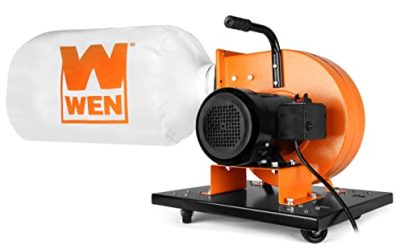
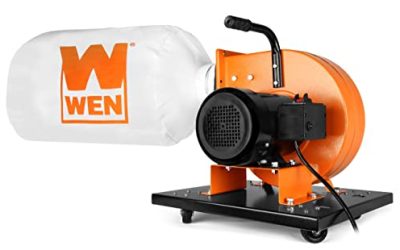
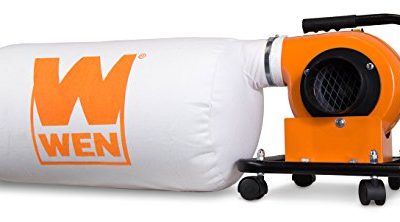
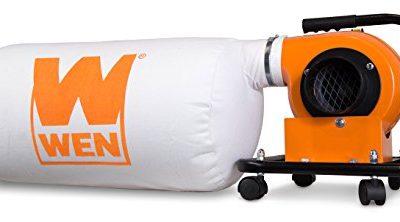
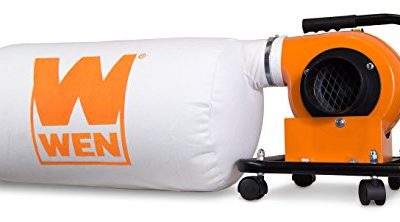
The WEN DC3401 is the hobbyist pick for a shop that is still evolving, because it refuses to lock you into one layout. Its 660 CFM airflow is the highest in this group, handling a table saw or a small jointer through a short hose, and at about 17 pounds it is the lightest unit here, so one person can lift it onto the bracket or take it down without help. The optional wall mount and the included mobile base mean the collector can hang beside the saw this year and roll to a new spot next year. The 12-gallon zippered bag empties in minutes.
Specs
- 5.7-amp motor with 6-inch impeller
- Airflow up to 660 CFM
- 12-gallon collection bag with zipper
- 5-micron filter bag
- Optional wall mount and mobile base included
- 4-inch dust port
- Weighs about 17 pounds
Best for: A hobby shop that rearranges often and needs a light, flexible collector with strong airflow.
Watch out for: The 5-micron bag passes fine sanding dust, so wear a respirator when sanding and consider a finer replacement bag as the hobby grows.
VEVOR DC100M

The VEVOR DC100M suits a hobbyist who settles into long, unhurried sessions and dislikes interruptions. Its 21-gallon non-woven collection bag holds nearly twice what compact collectors carry, so an afternoon of sawing and sanding runs without a pause. The 1 HP induction motor moves 560 CFM, the 2.5-micron bag handles fine dust, and the transparent window plus bottom zipper make checking and emptying straightforward. At about 24 pounds it is light for its capacity, which makes the wall installation a one-person job and the hobby feel less like maintenance.
Specs
- 1 HP induction motor
- Air suction capacity of 560 CFM
- 21-gallon (80 L) non-woven collection bag
- 2.5-micron filter bag
- Noise level of 90 dB or less
- Voltage of 120 volts, 60 Hz
- Dimensions with bag of 40.94 by 13.78 by 15.75 inches
- Weight of 24.03 pounds
Best for: A hobbyist who works long sessions and wants the fewest interruptions to empty the bag.
Watch out for: The tall bag needs vertical wall clearance, so measure the wall height and leave room below for the zipper to open fully.
Shop Fox W1826

The Shop Fox W1826 fits a hobby shop with one machine that never moves, where a permanent station is a feature rather than a limitation. Its 1 HP induction motor moves 537 CFM through a 4-inch intake, enough for a table saw, a bandsaw, or a router table used one at a time. The 2.5-micron cloth bag filters finer than budget bags, and the clear window on the lower bag shows the dust level without opening anything. The bracket locks to the wall with a screw, so the unit lifts off for cleaning and seats back on without tools, which suits a shop that values routine over rearrangement.
Specs
- 1 HP induction motor
- Air suction capacity of 537 CFM
- 2.5-micron cloth filter bag
- 4-inch intake hole
- Collection capacity of 2 cubic feet
- Static pressure of 7.2 inches
- Dual voltage 110V or 220V single-phase
- Wall mounting bracket with locking screw
Best for: A hobby shop with a fixed machine station and a settled layout.
Watch out for: The unit plus a full bag weighs over 50 pounds, so lag screws into studs are essential and the bracket spacing must match your studs.
BUCKTOOL DC30A-1

The BUCKTOOL DC30A-1 is the hobbyist pick for convenience, because its remote control starts and stops the motor from anywhere in the room. When the collector hangs above a bench or behind a machine, the remote removes the daily stretch for the switch, and that small comfort adds up over years of hobby sessions. The 1 HP totally enclosed fan-cooled induction motor moves 550 CFM, and the 2-micron bag traps fine sanding dust better than a 5-micron bag. It mounts on the wall or rolls on braked wheels, so the same unit adapts as the hobby evolves.
Specs
- 1 HP TEFC induction motor, 6.5 amps
- Airflow of 550 CFM
- 2-micron dust filter bag
- Remote control included
- 4-inch by 80-inch hose included
- Wall mount bracket and wheels with brake
- 9-inch balanced steel radial fin impeller
- Maximum static pressure of 5.8 inches of water
Best for: A hobbyist who wants the convenience of a remote control and a wall mount that can also roll.
Watch out for: The 80-inch hose limits how far the collector can sit from the machine, so mount it close to the saw or sander you use most.
Which One Fits Your Situation
Your shop rearranges every time a new tool arrives
Choose the WEN DC3401, the lightest unit here at about 17 pounds, with a wall mount and a rolling base both in the box. Its 660 CFM is the strongest airflow in the group, so it keeps up with the saw wherever it ends up. The 12-gallon bag is small, but the flexibility is worth more in a shop that never sits still.
You settle in for long, relaxed sessions and hate interruptions
Pick the VEVOR DC100M for its 21-gallon bag, which nearly doubles the time between emptying compared with compact units. The window shows the level at a glance, and the bottom zipper empties it without taking the unit down. Measure the wall height first for the tall bag. The bottom zipper empties the bag without taking the unit off the wall.
Your saw has lived in the same spot for years and will stay there
Hang the Shop Fox W1826 as a permanent station beside it. Its 2.5-micron bag and 537 CFM suit a single machine used one at a time, and the locking bracket makes removal for cleaning easy. Confirm the stud spacing matches the bracket before drilling. The clear window shows the dust level, so emptying never comes as a surprise.
You want the hobby to feel easy, not like a second job
Take the BUCKTOOL DC30A-1, because the remote control removes the daily walk to the switch and the 2-micron bag handles sanding dust well. Mount it high on the wall, keep the hose short, and start or stop it from wherever you stand. The braked wheels also let the unit roll to a second machine when the layout changes.
Common Mistakes
- Buying the most powerful collector and then finding it too heavy to hang on the available wall.
- Choosing a 5-micron bag for a small enclosed hobby shop, where fine dust settles on everything between sessions.
- Running a long hose across the shop, which bleeds suction and becomes a tripping hazard.
- Waiting until the bag is packed solid to empty it, which strains the motor and cuts airflow.
- Mounting on drywall anchors instead of lag screws into studs, risking the unit pulling free under a full bag.
Frequently Asked Questions
How much should a hobbyist spend on a first dust collector?
A hobbyist does not need the most expensive collector, but the cheapest unit often lacks the airflow or filtration that makes the hobby enjoyable. A 1 HP wall mounted collector moving 537 to 660 CFM covers the machines most hobbyists own, and a 2.5-micron bag is a sensible default. Buy for the hungriest machine you own, and prioritize a light unit that is easy to hang.
Is a wall mounted collector better than a floor unit for a hobby shop?
Yes, in a small hobby shop, because it frees the floor for lumber, benches, and projects in progress. A wall mounted unit also keeps the hose short when mounted beside the main machine, which improves suction. Dual-mount models like the WEN DC3401 and BUCKTOOL DC30A-1 offer both options, so the hobbyist can switch if the layout changes.
How do I know when the filter bag needs cleaning?
Airflow dropping noticeably during a session is the clearest sign, especially with a fine 1-micron or 2-micron bag after heavy sanding. A bag that looks puffed and dusty on the outside is also due for a brushing. Shake or brush the bag clean outdoors, and check the clear window on the collection bag at the same time.
Can a hobbyist install a wall mounted collector alone?
Yes, for the lighter models. The WEN DC3401 weighs about 17 pounds and the VEVOR DC100M about 24 pounds, so one person can lift them onto a bracket after driving lag screws into studs. Heavier fixed units like the Shop Fox W1826 may need a helper, especially once the bag is full. Always use lag screws into studs, never drywall anchors.