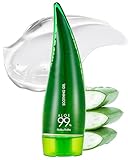
- Top Pick: Nature Republic Mild & Moisture Aloe Vera Watery Gel | 10.56 Oz
- Best Value: THESAEM Jeju Fresh Aloe Soothing Gel 10.1 fl. oz. – 99% Aloe Vera Leaf Juice from Jeju Island – Multi-Purpose Moisturizing Gel for Face, Body & Hair – Lightweight Cooling Hydration for Dry Skin
- Premium Choice: VENAMINE Korean Aloe Vera Soothing & Moisture Gel 100% For Face And Body organic pure aloe vera gel 300ml
TL;DR: Korean aloe vera gels range from near-pure leaf juice (INCI: Aloe Barbadensis Leaf Juice first) to complex multi-active formulas using aloe as a base. Purity, stabilization method, and acemannan content determine efficacy. Dual use as skincare and hair treatment is validated — here’s how to distinguish functional formulas from greenwashed ones.
Korean Aloe Vera Gel: INCI Analysis, Multi-Use Applications, and Buying Guide (2026)
Aloe vera (INCI: Aloe Barbadensis Leaf Juice, Aloe Barbadensis Leaf Juice Powder, or Aloe Barbadensis Leaf Extract) is one of the most researched cosmetic ingredients in existence — and one of the most adulterated. The Korean market has produced both the most authentic high-concentration aloe formulas available internationally and some of the most misleadingly marketed. Knowing what to look for in the INCI separates a genuinely useful korean aloe vera gel from a green-tinted moisturizer.
As an Amazon Associate we earn from qualifying purchases at no extra cost to you.




This guide covers the biochemistry of key aloe bioactives, INCI reading for purity verification, and the evidence base for multi-use applications across skin and hair.
🛒 Best Price Today on Amazon
Prime members get fast, free shipping on everything above, plus member-only deals. New members get a 30-day free trial — cancel anytime.
Start 30-Day Prime Free Trial →See Today’s Amazon DealsTop Picks at a Glance


As an Amazon Associate we earn from qualifying purchases. Product prices and availability are accurate as of the date/time indicated.





As an Amazon Associate we earn from qualifying purchases. Product prices and availability are accurate as of the date/time indicated.




As an Amazon Associate we earn from qualifying purchases. Product prices and availability are accurate as of the date/time indicated.
Key Aloe Bioactives: What Actually Does the Work
Aloe barbadensis leaf juice is a complex mixture. The clinically relevant components:
Acemannan (Aloe Polysaccharide)
The primary bioactive responsible for most of aloe’s documented skin benefits. A beta-(1,4)-acetylated mannan polymer with demonstrated:
- Wound healing acceleration via fibroblast stimulation
- Immunomodulatory effects (topical macrophage activation)
- Moisture retention via hygroscopic polysaccharide matrix
- Anti-inflammatory activity through multiple pathways
Acemannan content degrades rapidly after leaf processing. Cold-pressing and flash-pasteurization preserve more polysaccharide content than heat-processing. This is why processing method matters for efficacy — a claim rarely made on packaging but critical to outcome.
Aloin / Anthraquinones
Present in the latex layer between the leaf skin and gel. Aloin has laxative properties if ingested and is mildly irritating topically. Quality cosmetic aloe gel production removes the aloin-containing latex layer (referred to as “decolorized” or “purified” aloe). High-quality Korean aloe gels specify aloin content below 10 ppm — this is the benchmark for non-irritating topical formulas.
Aloe Sterols (Lophenol, 24-Methyl-Lophenol)
Plant sterols with documented emollient and barrier-supporting activity. More concentrated in specialized aloe sterol extracts than in standard leaf juice. These interact favorably with ceramides and cholesterol in the skin’s lipid bilayer.
Vitamins, Minerals, and Enzymes
Aloe leaf juice contains vitamins B12, C, E, and folic acid, plus zinc, selenium, and active enzymes (bradykinase, catalase). While concentrations are low relative to direct vitamin actives, these contribute to the overall bioactive profile and distinguish fresh-process aloe from reconstituted powder formats.
INCI Reading: How to Verify Aloe Purity
The most important INCI check: what is the first ingredient?
- “Aloe Barbadensis Leaf Juice” as first INCI: The product is primarily aloe. This is what you want for a high-concentration aloe gel. Most authentic Korean aloe gels in the 98–99% concentration claim fall here.
- “Aqua (Water)” as first INCI, aloe lower down: Water-based formula with aloe as an active — not inherently inferior, but the product is not primarily aloe. Aloe concentration may be 1–5%.
- “Aloe Barbadensis Leaf Juice Powder” vs. “Aloe Barbadensis Leaf Juice”: Powder requires reconstitution, which typically results in lower acemannan content due to processing. Fresh juice is preferable for bioactive preservation.
The “92%”, “98%”, “99%” concentration claims on Korean aloe gels refer to the percentage of aloe leaf juice in the total formula. The remaining 2–8% is typically carbomer (thickener), preservatives (phenoxyethanol, sodium benzoate), and fragrance. This is a legitimate measure of purity — but only when the INCI confirms the aloe is actually first.
INCI & Spec Reference Table
| Indicator | INCI Signal | Quality Interpretation |
|---|---|---|
| Primary ingredient | Aloe Barbadensis Leaf Juice (position 1) | High-concentration; genuine aloe gel |
| Processing quality | “Decolorized” / “purified” claim | Aloin removed; lower irritation risk |
| Thickener type | Carbomer, Xanthan Gum, Hydroxyethylcellulose | Carbomer = clear gel; xanthan = more natural |
| Preservation | Phenoxyethanol, Sodium Benzoate, Ethylhexylglycerin | Standard; check for parabens if relevant |
| Added actives | Niacinamide, Centella Asiatica, Hyaluronic Acid | Enhances utility beyond base aloe function |
| Fragrance concern | Parfum / Fragrance, Linalool, Limonene | Avoid for reactive/sensitive skin use cases |
Multi-Use Applications: Evidence-Based Overview
Skincare Applications
- After-sun soother: Best-documented use. Acemannan and aloe sterols reduce UV-induced erythema and TEWL. Apply liberally post-sun exposure.
- Lightweight daily moisturizer: For oily and combination skin in humid climates, high-concentration aloe gel provides adequate hydration without adding oils. Layer under SPF for summer routines.
- Barrier support (mild): Aloe polysaccharides support the glycoprotein matrix of the stratum corneum. Useful as part of a full barrier repair regimen — pair with ceramide products for stronger repair. See Korean barrier repair for damaged skin for full context.
- Primer/base layer: The gel texture of high-aloe formulas creates a smooth, blendable base under makeup or over toner in Korean layering routines.
- Sheet mask booster: Some Korean practices involve applying a thin layer of aloe gel before or after sheet masking to extend absorption. Aligns with the layering principle covered in our best Korean sheet masks guide.
Hair and Scalp Applications
- Scalp soothing: Acemannan’s anti-inflammatory properties carry over to scalp application. Reduces itching and flaking associated with mild seborrheic dermatitis.
- Leave-in conditioning: Aloe polysaccharides coat the hair shaft and reduce static and frizz. Apply to damp hair ends; the lightweight texture doesn’t weigh down fine hair.
- Curl definition: High-carbomer aloe gels provide hold with flexible definition — a common styling product in curly hair communities.
Frequently Asked Questions
Why do some Korean aloe gels turn yellow or brown over time?
Oxidation of aloe polyphenols and enzyme activity after opening. High-quality aloe gels include antioxidants (tocopherol, ascorbic acid) and appropriate preservative systems to extend stability. Yellowing indicates oxidative degradation; the product has lost significant bioactive potency and should be replaced. Store aloe gels in cool, dark conditions and use within 6–12 months of opening.
Is Korean aloe vera gel safe for sensitive and reactive skin?
True aloe vera contact allergy exists but is rare — estimated at less than 1% of the population. Sensitivity reactions attributed to “aloe” are more commonly triggered by aloin (anthraquinone fraction), added fragrances, or preservatives in the formula rather than the aloe itself. For sensitive skin, select decolorized (low aloin), fragrance-free formulas with minimal preservatives. Patch-test on the inner arm for 48 hours before full-face application. See the Korean cica skincare for sensitive skin guide for additional compatible ingredient recommendations.
Can I use Korean aloe vera gel as a moisturizer replacement?
As a sole moisturizer, high-concentration aloe gel is adequate for oily skin in humid conditions. It provides humectancy (polysaccharide water-binding) but lacks emollient and occlusive components needed to prevent TEWL in dry or cold conditions. For dry or combination skin, use aloe gel as a first hydrating layer, then follow with an emollient-containing moisturizer. This two-step approach aligns with the layering method in our Korean dry skin essentials routine.
What percentage of aloe should I look for in a Korean aloe gel?
For skin-soothing and post-sun applications: 92%+ aloe content (verified by INCI position). For barrier support as part of a layered routine: even 10–20% aloe in a supporting formula provides useful polysaccharide activity. The marketing claims of “99% aloe” are meaningful only if the INCI confirms Aloe Barbadensis Leaf Juice is the first listed ingredient — the percentage claim alone does not verify purity without INCI confirmation.
How do Korean aloe gels compare to growing your own aloe and using fresh gel?
Fresh leaf gel from home-grown aloe contains the highest acemannan concentration — within 30 minutes of cutting, before enzymatic degradation begins. However, fresh aloe contains aloin in the latex layer (yellow liquid between skin and clear gel), which is irritating and must be thoroughly washed off. Commercial Korean aloe gels remove aloin, standardize concentration, stabilize against oxidation, and add a preservation system for safety. For routine daily skincare use, a well-formulated commercial Korean aloe gel is more consistent and safer than DIY fresh gel.
Seasonal and Skin-Type Usage Guide
- Summer / Oily skin: Use as sole moisturizer morning and evening. Layer under SPF. Apply to damp skin after toner for maximum humectant uptake. Full context in our Korean summer skincare routine.
- Winter / Dry skin: Use as first hydration layer under emollient and occlusive products. Do not rely on aloe gel alone — add ceramide cream over the top.
- Acne-prone skin: High-concentration, fragrance-free aloe gel is one of the few universally low-comedogenicity hydrators. Integrate into the Korean oily/acne-prone routine.
- Teen skin: Lightweight texture and low irritation profile make aloe gel an ideal first moisturizing step. See our Korean teen skincare routine for integration guidance.
Final Verdict
Korean aloe vera gels, when genuinely high-concentration (92%+, Aloe Barbadensis Leaf Juice first in INCI, decolorized, fragrance-free), are among the most versatile and evidence-supported products in K-beauty. They deliver proven post-sun calming, lightweight daily hydration, mild barrier support, and functional hair and scalp applications in a single product. The category is heavily greenwashed — use INCI verification as your primary filter, ignore front-of-pack percentage claims without INCI confirmation, and prioritize fragrance-free formulas for any sensitive skin application.