Last updated: October 4, 2026
Most people researching the best at home microneedling devices want one thing: visible skin improvement without spending hundreds per session at a clinic. The appeal is real. A quality pen or roller can boost product absorption, soften fine lines, and improve texture over time. But the category is also littered with poorly made tools that bend, rust, or deliver inconsistent puncture depth, which means the wrong purchase wastes your money and risks your skin.
After detailed research across pens, rollers, and stamps, the gaps between good and mediocre are clear. Needle material matters more than brand name. Motor consistency separates a reliable pen from one that stutters and pulls. Needle count per cartridge dictates coverage speed. And cartridge replacement cost quietly determines whether a cheap pen becomes expensive over a year. Below is every device we evaluated, ranked by how well it performs the job it claims to do.
As an Amazon Associate we earn from qualifying purchases at no extra cost to you.



Quick Picks
| Product | Best for | Price |
|---|---|---|
| Dr pen M8 Microneedling Pen | Overall performance value | under $90 |
| Dr Pen M8 with 20 Cartridges | Bulk cartridge buyers | under $100 |
| Microneedle Derma Roller Pen | Budget entry into microneedling | under $40 |
| AKIYRO Derma Roller 0.30mm | Multi-area use (face, beard, scalp) | under $30 |
| Dr.pen M9 Microneedling Pen | Upgraded motor and precision | under $150 |
| Hydra Needle Derma Stamp | Targeted serum application | under $20 |
| Microneedling Pen Derma Roller | Mid-range pen with roller combo | under $70 |
| Micro-Infusion System for Face & Neck | All-in-one kit with serums included | under $200 |
How We Picked
We evaluated each device on four criteria: needle quality and material (titanium tips held up better than steel across repeated use), motor or mechanism consistency (does the pen maintain steady vertical strokes or does it drag?), real cost of ownership including cartridge replacement pricing, and ease of sanitizing between sessions. A device that scores well on one but fails on sanitation is not worth recommending for at-home use.
The 8 Best At Home Microneedling Devices in 2026
Dr pen M8 Microneedling Pen for Home Use
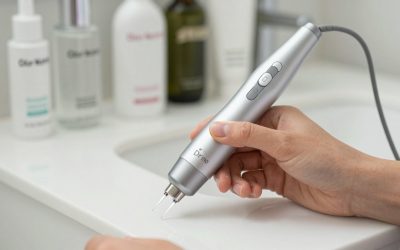
This is the pen most experienced home users start with and never feel the need to upgrade from. The motor holds speed consistently across the face without the pulsing drag that cheaper pens develop after a few sessions. Needle depth is adjustable in fine increments, which lets you keep treatments shallow around the eyes and deeper on the jawline where collagen loss shows first.
- Pro: Smooth, consistent motor with no stuttering at higher speeds
- Pro: Fine depth adjustment range covers most face zones
- Con: Only one cartridge included; replacements add to the true cost
Skip this if you have never microneedled before and want a lower financial commitment while learning your technique.
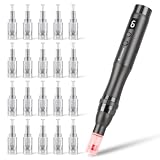
Dr Pen M8 Microneedling Pen with 20 Cartridges for Home Use – 0.25mm
The same M8 platform sold with a generous cartridge bundle. For anyone planning weekly or biweekly sessions, twenty cartridges eliminates the need to reorder for months. The 0.25mm fixed depth suits users focused on product absorption and mild texture work rather than deep collagen stimulation.
- Pro: Cartridge bundle slashes long-term cost versus buying replacements individually
- Pro: Fixed 0.25mm depth is forgiving for beginners
- Con: Fixed depth means you cannot treat thicker areas with the same pen
Skip this if you need variable depth or want to treat multiple facial zones differently.
Microneedle Derma Roller for Skin, 0.25mm Microneedling Pen for Women Men Home Use
Under forty dollars gets you a functioning starter device with no motor and no cartridge system. It works. But the needle alignment and hand-forged tips are noticeably less uniform than pricier options, so coverage is slightly uneven on curved surfaces like the nose.
- Pro: Lowest pen-format price among tested devices
- Pro: No cartridges to replace; reusable after sanitizing
- Con: Needle uniformity is inconsistent across the roller head
Skip this if you care about even coverage or plan to use it beyond a few weeks.
AKIYRO Derma Roller 0.30mm – Microneedle Roller with Storage Case
A straightforward roller at under twenty-five dollars that earns its place through versatility. The 0.30mm length handles face, beard area, and scalp in one tool. The included storage case prevents tip contact during travel, which is the most common cause of premature needle dulling.
- Pro: One roller covers multiple body areas
- Pro: Protective storage case included at this price point
- Con: 0.30mm is a single fixed depth with no adjustability
Skip this if you need separate depths for face versus body.
Dr.pen M9 Microneedling Pen for Home Use
The M9 steps up from the M8 with a refined motor that runs quieter and holds torque at lower speeds. Depth adjustment has a wider range, useful if you want to push past 1.0mm on thicker skin. Build quality feels denser and more clinical.
- Pro: Quieter, more consistent motor with better low-speed control
- Pro: Wider depth range suits experienced users
- Con: Cartridges are proprietary and costlier than generic alternatives
Skip this if you are new to microneedling; the M8 at half the price will serve you until your technique matures.
Serum Applicator Hydra Needle Derma Stamp 0.25mm Titanium Microneedling Roller Stamp
A hybrid stamp and applicator that holds serum in its reservoir while the titanium micro-needles create channels for absorption. The 0.25mm depth is ideal for gentle, frequent use. Serum is not included, which is a notable omission at first glance, but the device itself is inexpensive enough that the total kit cost stays competitive.
- Pro: Built-in serum reservoir eliminates separate application step
- Pro: Titanium needles resist corrosion better than steel
- Con: Stamp format is slow for full-face coverage
Skip this if you want speed across larger areas.
Microneedling Pen Microneedle Derma Roller Pen for Face Skin, 0.25mm
A mid-range option that pairs a motorized pen with a 0.25mm derma roller in one kit, letting you choose the format per session. The pen motor is adequate but not as smooth as the Dr.pen line, and the roller is functional though unremarkable. It works best for users who genuinely want two tool types in one box.
- Pro: Includes both pen and roller formats in one purchase
- Pro: Reasonable mid-range pricing for a two-in-one kit
- Con: Neither component matches dedicated single-format devices at similar cost
Skip this if you know which format you prefer; a dedicated device is usually better.
Micro-Infusion System for Face & Neck
The most complete kit on this list. You get a 0.25mm stamp, a hydrating spray, and blue copper peptide serum in a three-month supply. The copper peptide is a genuine active for firmness and wrinkle appearance, and having it pre-measured removes guesswork. The five-minute routine format suits users who want structure over experimentation.
- Pro: All-in-one system with clinically relevant active (copper peptide)
- Pro: Structured routine reduces decision fatigue
- Con: Highest upfront cost on the list
Skip this if you already own serums and need only the device.
Buying Guide
Needle Material and Tip Quality
Titanium tips are the standard for home devices. They resist corrosion, maintain sharpness longer, and create cleaner punctures that heal faster than dull or burred steel. If a product does not specify titanium, assume steel and plan on replacing the head more frequently. Check for a visible seam at the needle base where cheap manufacturing leaves a rough edge that can scratch skin during strokes.
Motor Consistency and Speed Range
A good pen motor maintains the same needle-in speed at 8,000 rpm as at 12,000 rpm. Stuttering or speed drops mean the needle lingers too long in tissue, increasing trauma without increasing benefit. If you can, test at low and high speeds before committing. Pen-format devices win on speed for full-face work; rollers and stamps suit targeted areas where you want to see exactly where each puncture lands.
Cartridge Availability and True Ownership Cost
Compare the total cost over six months: device price plus cartridges. Some pens look cheap at forty dollars but use proprietary cartridges that cost more per unit than the device itself pays back over a year. Devices using universal or widely available cartridge sizes let you shop around. Buy cartridges in bulk when possible to lower per-unit cost, and always check whether your chosen brand has compatible replacements in stock before your current cartridge wears out.
Our Verdict
Top pick: The Dr pen M8 Microneedling Pen offers the best balance of motor quality, depth adjustability, and long-term cartridge availability in the tested range. Budget pick: The AKIYRO Derma Roller at 0.30mm gives you a corrosion-resistant, multi-area tool for under twenty-five dollars with a protective case included. If you want the simplest possible routine without assembling serums yourself, the Micro-Infusion System wins despite its higher upfront price because it removes every guesswork step.
FAQ
How often can I microneedle at home?
With 0.25mm depth, most skin types tolerate use two to three times per week because the punctures remain in the upper epidermis. Deeper settings at 0.5mm or above should be limited to once every two to four weeks to allow full healing between sessions.
Can I microneedle if I have active acne?
No. Needles over active breakouts spread bacteria across the skin and push contents deeper into tissue, which can worsen the breakout or cause secondary infection. Wait until the skin is clear of pustules and treat only closed comedones or post-acne texture.
What serums are safe to use after microneedling?
Stick to simple, non-irritating formulas: hyaluronic acid, niacinamide, and peptide solutions are well tolerated. Avoid retinoids, high-concentration vitamin C, and any product with fragrance or essential oils for at least twenty-four hours after a session.
Do microneedling results last?
Collagen stimulation from microneedling is real but gradual. Visible improvement in fine lines and texture typically appears after six to eight weeks of consistent use, and maintenance sessions keep the result stable. Stopping entirely means your skin will return toward its baseline over several months.
Part of our devices buying guide hub.