Last updated: October 7, 2026
- Best Laser Hair Removal Devices for Home Use: The Short Answer
- True Laser Versus IPL: The Difference That Matters
- Head-to-Head Comparison of Leading Home Devices
- Which Device Fits Your Situation?
- Safety Sensors and Power Settings
- Speed: A Useful Cost-per-Use Calculation
- Replacement Parts, Cleaning, and Durability
- How to Use a Home Device More Reliably
- Related Guides
Quick answer: For most people in 2026, the best laser hair removal devices for home use is the Tria Hair Removal Laser 4X — our #1 rated choice. See the full ranked comparison, alternatives and buying advice below.
Best Laser Hair Removal Devices for Home Use: The Short Answer
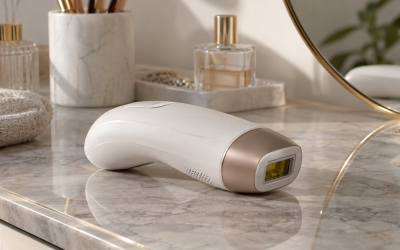
The best laser hair removal device for home use depends on whether you want the concentrated treatment of a true diode laser or the faster, broader coverage of IPL: choose the Tria Hair Removal Laser 4X for genuine home laser technology and small treatment areas, or choose an IPL model such as the Braun Silk-expert Pro 5, Philips Lumea 9000, or SmoothSkin Pure Fit when speed, automatic skin sensing, and full-body coverage matter more.
These devices are not interchangeable. A diode laser emits one concentrated wavelength, while IPL (intense pulsed light) emits a broad band of light. Both are designed to heat pigment in the hair follicle, but home devices vary considerably in coverage, operating speed, skin-tone safeguards, power adjustment, and long-term ownership cost.
True Laser Versus IPL: The Difference That Matters
True diode laser
A home diode laser, such as the Tria 4X, uses a narrow wavelength around 810 nm. Its small treatment window delivers concentrated energy to one area at a time. This can make it useful for the face, bikini line, and individual stubborn areas, but treating both legs takes patience.
The main trade-off is coverage. A true laser device may treat a small spot in a single pulse, whereas an IPL handset can cover a much larger patch of skin with each flash. The Tria 4X also requires a close match between hair color and skin tone and is not suitable for every complexion. Read the manufacturer’s compatibility chart rather than relying on the device name alone.
IPL
IPL devices use multiple wavelengths, commonly across a range of roughly 500 to 1,200 nm. They are usually faster for legs, arms, chest, and back because their windows are larger and their flash rates are quicker. Braun, Philips, SmoothSkin, and Ulike models fall into this category, despite many listings using “laser hair removal” as a general search term.
IPL is not automatically weaker or less useful. Its practical advantage is efficient coverage. Its limitation is that the broad light spectrum and intense heat require careful skin-tone screening. Most reputable models prevent or limit flashing when the sensor detects that the skin is too dark for that setting.
Head-to-Head Comparison of Leading Home Devices
| Device or type | Technology | Typical treatment window or area | Power and speed controls | Sensor and safety features | Ownership considerations |
|---|---|---|---|---|---|
| Tria Hair Removal Laser 4X | 810 nm diode laser | About 1 cm² window | 5 intensity levels; approximately 22 J/cm² maximum published fluence | Skin-contact and skin-tone checks; will not operate on unsuitable tones | Cordless; slower treatment; no conventional replacement lamp |
| Braun Silk-expert Pro 5 | IPL | About 3 cm², depending on head | 10 energy levels; gentle and standard modes; up to roughly 2 flashes per second on some versions | Continuous skin-tone sensing and automatic energy adjustment | Corded; commonly rated for about 400,000 flashes; multiple precision heads on selected kits |
| Philips Lumea 9000 Series | IPL | Body windows commonly around 4 cm²; attachments vary | 5 intensity settings; stamp and glide modes | Skin-tone sensor, skin-contact detection, and dedicated attachments on many kits | Often cordless as well as corded; lamp is generally not user-replaceable |
| SmoothSkin Pure Fit | IPL | Approximately 3 cm² window | Automatic mode plus lower-comfort settings; rapid flash rate, often under 1 second between flashes | Integrated skin-tone sensor and full-contact operation | Corded; high flash-life rating; replacement lamp is not normally a routine purchase |
| Cooling IPL category, including Ulike Air models | IPL with cooling feature | Usually around 3 to 4 cm² | Several intensity levels, often including a low-comfort mode | Skin-contact detection and skin-tone guidance; exact safeguards vary by model | Cooling can improve comfort; check whether the exact kit is corded and whether a precision head is included |
Specifications can differ by regional model and bundle, so treat the figures above as practical comparison points rather than a substitute for the manual. A larger window and faster flash rate do not necessarily mean higher energy per square centimetre.
Which Device Fits Your Situation?
| Your priority | Best fit | Why | What to accept as a compromise |
|---|---|---|---|
| You specifically want a true laser | Tria 4X or another approved home diode laser | Concentrated 810 nm laser energy and precise spot treatment | Small window, slower sessions, and more noticeable heat |
| You want to treat legs quickly | Braun Silk-expert Pro 5 or SmoothSkin Pure Fit | Fast flashing, automatic sensing, and broad treatment coverage | Usually corded and still dependent on suitable hair and skin contrast |
| You need cordless flexibility | Selected Philips Lumea 9000 models | Useful for moving between rooms and treating without a power cable | Battery sessions can be slower or less convenient when the charge is low |
| You are new to home light devices | An IPL model with automatic sensing | The sensor reduces guesswork about intensity and contact | Automatic adjustment may not deliver the same setting on every body area |
| You are especially concerned about comfort | An IPL model with a gentle mode or active cooling | Lower settings and cooling can make regular use easier to tolerate | Comfort modes may reduce energy and require consistent treatment |
Safety Sensors and Power Settings
A good safety sensor does more than confirm that the window is touching your skin. The most useful systems read skin tone before or during a flash and either select an energy level or block the pulse. This matters because recently tanned, sun-exposed, or naturally deeper skin contains more pigment that can absorb light.
Automatic sensing is helpful, but it is not permission to treat every area. Do not flash over tattoos, dark moles, very dark spots, or irritated, broken, or recently sunburned skin unless the manufacturer specifically provides a safe procedure. Covering a mole with an opaque barrier is commonly advised, but follow the individual manual.
Manual intensity levels are valuable when you are learning your comfort threshold. Start at the lowest recommended setting and perform a patch test. If there is prolonged pain, blistering, marked swelling, or a skin-color change, stop using the device and seek medical advice. Anyone with a photosensitive condition, light-sensitive medication, or uncertainty about a skin lesion should consult a qualified healthcare professional before treatment.
Speed: A Useful Cost-per-Use Calculation
Consider a simplified example. Suppose an IPL device costs $350 and you use it once weekly for the first 12 weeks, then once every four weeks for 12 months. That is approximately 24 sessions during the first year. The device cost works out to about $14.58 per session before considering electricity:
$350 ÷ 24 sessions = $14.58 per session
If the device takes 15 minutes for both legs and you continue for 30 sessions, the hardware cost becomes about $11.67 per session. A true laser with a 1 cm² window may take substantially longer for the same area, even if it is the better match for someone who prefers concentrated laser treatment. The cheapest device is therefore not always the one with the lowest ownership cost: a device you will actually use consistently has greater practical value.
Replacement Parts, Cleaning, and Durability
Most home IPL devices advertise hundreds of thousands of flashes, and many are designed for years of ordinary use without a lamp replacement. This makes them different from professional systems with serviceable lamps. In home devices, the parts most likely to create ownership costs are the power cable, charging system, cooling components, treatment head, and battery rather than a replaceable light cartridge.
- Replacement heads: precision or sensitive-area heads may cost roughly $30 to $100 when sold separately, although availability varies.
- Power adapters: a replacement can commonly cost about $20 to $60, and proprietary adapters may be harder to source.
- Battery service: cordless models may require manufacturer service after several years; the battery is usually not designed for home replacement.
- Light sources: many IPL models have sealed, non-replaceable lamps. A high flash rating does not guarantee unlimited life.
- Cleaning: unplug the device, let it cool, and wipe the window with a soft, dry or lightly dampened cloth as directed. Avoid alcohol, abrasive cleaners, oils, and water entering the housing.
For durability, do not drag the flash window across skin, use the device on lotion or oil, block ventilation openings, or store a cordless unit permanently at extreme heat. Hair, sweat, and cosmetic residue on the window can reduce contact quality and make flashes feel hotter.
How to Use a Home Device More Reliably
- Check eligibility first. Compare your skin tone, hair color, medications, tattoos, and relevant health conditions with the manual.
- Shave the area. Surface hair can absorb light and increase odor or discomfort. Do not wax or epilate immediately beforehand because the follicle is the target.
- Perform a patch test. Use the recommended low setting and wait for the period specified by the manufacturer before treating a larger area.
- Keep a schedule. Follow the device’s initial treatment interval rather than flashing the same area repeatedly in one session.
- Use full contact and overlap carefully. Place the window flat against the skin and move in a grid so you do not miss strips or repeatedly treat one spot.
- Protect the treated skin. Avoid unnecessary sun exposure and follow the manual’s sun-protection instructions between sessions.
Results vary with hair color, skin tone, body area, hormones, and consistency. Light-based home devices generally work best where there is visible contrast between darker hair and lighter skin; blond, red, gray, and white hair may respond poorly. If you need treatment for a medical or hormonal hair-growth concern, discuss professional options with a dermatologist rather than relying on a consumer device.
Ready to decide? Our #1 pick for 2026 is the Tria Hair Removal Laser 4X.
Live price & availability on Amazon.