Last updated: September 27, 2026
CeraVe Moisturizing Cream and La Roche-Posay Toleriane moisturizers are two of the most recommended fragrance-free options for sensitive and barrier-damaged skin. They are often mentioned in the same breath, yet they are built for different textures and priorities. This comparison focuses on the CeraVe cream versus La Roche-Posay Toleriane Double Repair Face Moisturizer, the Toleriane most often compared with it, and helps you pick based on skin type and routine.
Quick comparison
| Feature | CeraVe Moisturizing Cream | La Roche-Posay Toleriane Double Repair |
|---|---|---|
| Texture | Thick, rich cream | Light, fluid lotion-cream |
| Key ingredients | Ceramides 1, 3, 6-II, hyaluronic acid, petrolatum | Ceramide-3, niacinamide, glycerin, thermal spring water |
| Fragrance | Fragrance-free | Fragrance-free |
| Use area | Face and body | Face |
| Typical size and price | 16 oz tub ~$15–22 | ~2.5–3.4 oz ~$20–26 |
| Price per oz | ~$1–1.40 | ~$6–9 |
How the formulas differ
CeraVe: occlusive and replenishing
CeraVe combines three ceramides with cholesterol and fatty acids that mirror the skin’s own barrier lipids, plus hyaluronic acid to attract water and petrolatum to seal it in. The brand’s controlled-release delivery system is designed to release ingredients over time. The result is a heavy, cushiony cream that stays on the skin.

CeraVe Moisturizing Cream, Face & Body Moisturizer for Dry Skin, 19oz
Included for 'CeraVe Moisturizing Cream vs La Roche-Posay Toleriane: Which Is Better?' because the listing specifies Face & Body Moisturizer for Dry Skin and 19oz, details this guide uses to compare options.
View on Amazon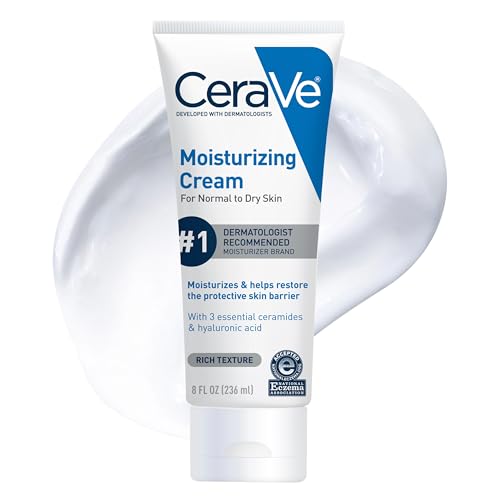
CeraVe Moisturizing Cream, Face Body Moisturizer, Normal to Dry Skin, 8 Fl Oz
Included for 'CeraVe Moisturizing Cream vs La Roche-Posay Toleriane: Which Is Better?' because the listing specifies Face Body Moisturizer and Normal to Dry Skin, details this guide uses to compare options.
View on Amazon
CeraVe Moisturizing Cream, Face & Body Moisturizer, Dry Skin, 16oz Refill
Included for 'CeraVe Moisturizing Cream vs La Roche-Posay Toleriane: Which Is Better?' because the listing specifies Face & Body Moisturizer and Dry Skin, details this guide uses to compare options.
View on AmazonLa Roche-Posay: lighter barrier support with niacinamide
Toleriane Double Repair pairs ceramide-3 with niacinamide and glycerin in a lightweight, oil-free base. Niacinamide may help the look of redness and supports barrier function. It absorbs faster and sits well under sunscreen and makeup.
Which suits your skin type?
| Skin type | Better choice | Why |
|---|---|---|
| Very dry, flaky | CeraVe | Richer occlusion and lipids |
| Normal | Either | Choose by preferred texture |
| Oily or combination | La Roche-Posay | Lighter, oil-free finish |
| Acne-prone | La Roche-Posay | Less heavy; patch test either way |
| Sensitive, redness-prone | Either; LRP if redness is the focus | Both fragrance-free; LRP adds niacinamide |
| Retinoid users with dryness | CeraVe at night | Cushions irritation |
Using them day vs. night
Many people end up using both: Toleriane in the morning under sunscreen for a light, non-greasy base, and CeraVe at night or on dry patches. The CeraVe tub also doubles as a body cream for elbows, hands and legs, which makes it outstanding value per ounce.
Layering tips
- With retinoids: apply retinoid, wait, then CeraVe to reduce dryness.
- With vitamin C: Toleriane layers more smoothly under SPF in the morning.
- With exfoliating acids: either cream helps support the barrier afterward.
Seasonal switching
Skin needs shift with climate. In humid summers, many people who normally love the CeraVe cream find it too heavy on the face and move to Toleriane or another light lotion. In cold, dry winters or in heated, low-humidity rooms, Toleriane alone may leave dry skin tight by midday, and a thin layer of CeraVe on top or at night fixes it. If your skin feels tight within an hour of moisturizing, go richer; if it looks shiny or you notice new clogged pores, go lighter.
Cost over a year
Using about 1 g per facial application twice daily, a 16 oz CeraVe tub lasts many months even with some body use, working out to a few cents per application. Toleriane Double Repair at around 75–100 ml lasts roughly 6–10 weeks of twice-daily facial use. Over a year, expect to spend around $20–40 on CeraVe versus $100–150 on Toleriane at typical prices.
Packaging and hygiene
CeraVe’s large tub is cost-effective but requires dipping fingers in; use a clean spatula to keep it hygienic. CeraVe also offers the cream in a pump. La Roche-Posay uses a tube or pump bottle, which is more travel-friendly and hygienic.
Who should avoid them
Both are designed for sensitive skin, but no product suits everyone. If you have known sensitivity to niacinamide, test Toleriane on a small area first. Very oily or clog-prone skin may find the CeraVe cream too heavy on the face. Anyone with allergies should scan the ingredient lists; formulas can change, so check the current label. Persistent rashes, burning or eczema flares warrant a visit to a dermatologist rather than switching creams.
FAQ
Is CeraVe cream too heavy for daytime?
For oily or combination skin, it can feel greasy under sunscreen. For dry skin in cold weather, a thin layer works well in the morning.
Which is better for eczema-prone skin?
Both are commonly recommended fragrance-free options. CeraVe’s heavier occlusion suits dry patches; LRP’s lighter feel suits daily facial use. Anyone with active eczema should follow their dermatologist’s guidance.
Bottom line
CeraVe Moisturizing Cream is the richer, far cheaper-per-ounce option that shines on dry, flaky or retinoid-stressed skin and doubles as a body cream. La Roche-Posay Toleriane Double Repair is the lighter, niacinamide-boosted choice for oily, combination or redness-prone faces and layers better under sunscreen. Choose by texture and skin type, or use both across day and night.