Last updated: November 22, 2026
- Quick answer
- Compound W Freeze Off Advanced Wart Remover
- Dr. Scholl’s Freeze Away Wart Remover
- Compound W Maximum Strength Fast-Acting Gel
- WartStick Maximum Strength Solid-Stick Wart Remover
- Compound W One Step Pads
- How to choose
- Who should skip
- Frequently asked questions
- Final verdict
- Product and ASIN Reference
Warts are small, rough growths caused by a common virus in the top layer of skin, and the ones on hands and the soles of feet are the types home treatment is actually made for. Drugstore removers work in two ways: freezing kits destroy the wart tissue in one or a few sessions, while salicylic acid products peel it away layer by layer over days or weeks. The five products below cover both methods in the main formats, gel, stick, pads and two freeze kits, all labeled for common and plantar warts.
As an Amazon Associate, we earn from qualifying purchases.
Quick answer
For a single stubborn wart, a freeze kit such as Compound W Freeze Off Advanced or Dr. Scholl’s Freeze Away works fastest. For slower, gentler treatment, salicylic acid is the classic route: WartStick gives the strongest stick format, Compound W Fast-Acting Gel suits small spots, and Compound W One Step Pads combine medication with a cushioning bandage for feet.
Compound W Freeze Off Advanced Wart Remover

This is the freezing option for people who want the fewest possible applications. The kit holds 15 treatments and uses an Accu-Freeze precision tip applicator, which focuses the cold on the wart instead of the healthy skin around it. That precision matters most on fingers and toes, where a wart sits close to skin you do not want to freeze. Compound W labels it for both common warts and plantar warts, and the brand states that some warts clear after a single treatment, although larger, older or deeper plantar warts can need repeat applications spaced out following the label directions. The treatment itself takes under a minute: the applicator is charged from the canister, held on the wart for the time the instructions set for that wart size and location, and then the frozen tissue gradually separates over the following days. A blister under the wart is a normal part of the process. Because the canister is pressurized and flammable, it needs storing away from heat, and the kit is not for facial or genital warts. Pick this one for one or two well-defined warts when patience for daily routines is low.
Dr. Scholl’s Freeze Away Wart Remover

Dr. Scholl’s takes the same cryotherapy approach in a 12-count kit built around foam applicator sticks. The applicator attaches to the nozzle of the can, locks in place with a twist, and is charged with the freezing agent before being pressed onto the wart. The listing labels it for common and plantar warts on hands and feet and rates it for use on children ages four and up, which makes it the freeze kit to look at for a family bathroom cabinet. As with the Compound W kit, the brand positions it as able to remove warts in as little as one treatment, with repeat treatments allowed by the label when a wart is large or stubborn. The foam tip is a little broader than a precision pen tip, so it suits round, raised common warts and flatter plantar warts well, while very small warts tucked beside a nail may be easier to treat with a gel or stick instead. Twelve applications give some room for a second wart or a repeat session without buying a second kit. Keep the same cautions in mind: hands and feet only, never the face, and adult supervision for children.
Compound W Maximum Strength Fast-Acting Gel

The gel is the traditional salicylic acid route in its most controllable form. It comes in a small 0.25 fl oz tube of maximum strength gel that you place directly on the wart, where it dries in place rather than running onto surrounding skin the way thin liquids can. That control makes it a good match for small common warts on fingers and the backs of hands, and for plantar warts once the thick surface has been soaked and softened in warm water. The routine is the trade-off: salicylic acid works by dissolving the wart a thin layer at a time, so the label routine is a daily application, usually after soaking the area for a few minutes and drying it, repeated until the wart is gone. Labels for this class cap home treatment at 12 weeks, and most warts need several of those weeks. Filing away softened dead skin between applications, with a disposable file kept for that wart only, helps the gel reach fresh tissue. Stop and reassess if the skin becomes raw or painful. Choose the gel if you want the lowest-fuss acid format and can commit to a daily habit.
WartStick Maximum Strength Solid-Stick Wart Remover
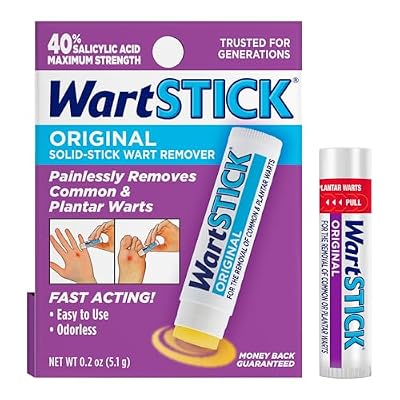
WartStick takes salicylic acid to its highest over-the-counter strength, 40 percent, and puts it in a solid stick that twists up like a lip balm. The waxy base, built on castor oil, paraffin, rosin and yellow wax, holds that strong acid exactly where you rub it on, with nothing to drip, spill or dry out in the tube. Made by Balassa Laboratories, the 0.2 oz stick is labeled for both common and plantar warts. The format shines on thick plantar skin, where a heavy layer can be built up by hand and then covered with a bandage or sock, and on small finger warts where a liquid brush would flood healthy skin. Because the concentration is the maximum sold without a prescription, the surrounding skin deserves protection: many people ring the wart with a thin layer of petroleum jelly first, and the stick should never go on the face, mucous membranes, moles or irritated skin. It asks for the same daily consistency as the gel, over a course the label limits to 12 weeks, but each application takes seconds and the stick travels well. This is the pick for thick, stubborn warts on tolerant skin.
Compound W One Step Pads

One Step Pads fold the whole salicylic acid routine into a single adhesive pad. Each of the 14 medicated pads carries maximum strength salicylic acid on a cushioned, self-adhesive disc: peel, stick it over the wart, and the pad medicates, covers and pads the spot at the same time. That cushioning is why this format earns its place for plantar warts, which sit on weight-bearing skin and can hurt with every step while they are being treated. The label cycle is a fresh pad every 48 hours, repeated until the wart clears, within the same 12-week ceiling that applies to salicylic acid treatments generally. Between pads, soaking the foot and removing softened dead skin keeps the acid working on live wart tissue instead of a crust. The pads also keep the treatment hidden and contained, which helps for warts on the backs of hands during the working day. They are less ideal for warts in skin folds or right against a nail, where a pad will not sit flat, and the adhesive needs dry skin to hold. Choose the pads when you want treatment and protection in one step with the least daily effort.
How to choose
Start with the method. Freezing kits are the fast route: one short application, then a wait while the treated tissue separates, with repeats only if the wart survives. Salicylic acid is the slow route: nothing dramatic happens on any single day, but the wart is dissolved gradually, and success depends on daily application for weeks. Next, match the format to the location. Plantar warts grow under thick, weight-bearing skin, so pads that cushion while they medicate, or a strong stick whose layer can be built up, usually serve feet best. Small warts on fingers reward precision, which is where a gel or the stick earns its keep. Then read the safety limits before buying anything. Salicylic acid labels bar use on the face, genitals and mucous membranes, and on moles, birthmarks, warts with hair growing from them, and irritated or infected skin. People with diabetes or poor blood circulation should not use any over-the-counter wart remover without asking a doctor first, because slow-healing feet change the risk completely. Home freezing kits carry their own minimum ages and are cleared for common and plantar warts only. Finally, keep warts and skin tags separate in your mind: both brands here sell dedicated skin tag kits, and a wart product is not a substitute for one, or the other way around.
Who should skip
Skip every product on this page and see a clinician instead if the growth is on your face, eyelids or genitals, if it grows out of a mole or birthmark, or if you are not actually sure it is a wart. Misidentifying a skin lesion is the biggest risk in home wart treatment. People with diabetes, poor circulation or a weakened immune system should also skip self-treatment and get medical advice first, as should anyone whose wart is red, infected, bleeding or painful. Freeze kits are not for children younger than the age printed on the box, and salicylic acid labels direct anyone pregnant or breastfeeding to ask a doctor before use. If a wart has not cleared inside the label treatment window, keeps multiplying, or comes straight back after a full course, that is a job for a dermatologist.
Frequently asked questions
How long does a wart remover take to work?
Freezing kits act in one session, and the treated wart usually darkens, blisters and separates within about two weeks, although large warts may need a repeat treatment after the label waiting period. Salicylic acid is slower: used daily, it removes the wart layer by layer, and labels allow up to 12 weeks before you conclude it is not working.
Can I use these removers on my face or on skin tags?
No. Every product here is labeled for common and plantar warts on hands and feet only. Facial warts, genital warts and warts on mucous membranes need a clinician, both because the skin is more delicate and because growths in those areas are not always warts. Skin tags are a different growth entirely, treated with separate dedicated products or removed in a clinic.
Why did my wart come back after it cleared?
Warts are caused by a virus in the skin, and a treatment can remove the visible growth while virus remains in the surrounding area, so a wart can regrow in the same spot. Finishing the full labeled course, avoiding picking at the wart, not sharing files, pumice stones or towels, and keeping feet clean and dry all reduce the chance of a return or spread.
Should I cover the wart while treating it?
Covering helps. A bandage over gel or stick applications keeps the acid in contact with the wart and off socks, shoes and other skin, and the medicated pads in this roundup are a cover by design. Whatever you use, wash hands after applying, keep the area clean, and stop if the surrounding skin becomes very sore, since that usually means acid is landing where it should not.
Final verdict
There is no single best wart remover, only a best match for the wart in front of you. For speed on one or two defined warts, choose a freeze kit: Compound W Freeze Off Advanced for its precision tip, or Dr. Scholl’s Freeze Away for a family-friendly 12-count box. For gradual treatment, WartStick brings the strongest acid in the neatest format, the Compound W gel suits small, precise spots, and One Step Pads are the set-and-forget option for sore plantar warts. Whichever route you take, the label limits matter more than the brand: respect them, finish the course, and leave stubborn growths to a dermatologist.
Product and ASIN Reference
| Product | ASIN |
|---|---|
| Compound W Freeze Off Advanced Wart Remover, 15 Treatments | B00SD9IEQM |
| Dr. Scholl’s Freeze Away Wart Remover, 12 Count | B0788BWQ8G |
| Compound W Maximum Strength Fast-Acting Gel, 0.25 fl oz | B000052XPI |
| WartStick Maximum Strength Solid-Stick Wart Remover, 0.2 oz | B00SHK1EFK |
| Compound W One Step Pads, 14 Medicated Pads | B000QWLOZW |