Last updated: November 23, 2026
A vertical masticating juicer only earns its place in a morning routine if the full cycle is short: loading produce, pressing it, pouring a glass, and rinsing the parts before work. The real decision is not raw power. It is how much chopping the feed chute demands at 7 a.m., how much counter the machine claims all day, and whether cleanup takes two minutes or ten.
This guide is for households juicing for two or more people, solo juicers with a narrow counter, and anyone whose current machine sits in a cupboard because washing it feels like a project. Every model below is a vertical slow juicer sold on Amazon US, and the specifications are taken from the product names and details on each Amazon listing.
Quick Picks
As an Amazon Associate we earn from qualifying purchases.
| Product | Best for | Key spec from title |
|---|---|---|
| Kuvings AUTO10 | Loading a full batch and walking away | 100 oz batching hopper, 240W motor |
| Kuvings REVO830 | Mixed produce with long celery and carrots | Extra wide 88mm and 48mm food chutes |
| Hurom H320 | Family-size morning batches | Self-feeding hopper, coarse strainers included |
| Omega VSJ843QS | A compact footprint and a slow 43 RPM press | 150W, 3-stage auger, no-drip tap |
How to Choose
Hopper and chute size decide your prep time
The loading system is the feature you feel every single morning. A batching hopper, like the 100 oz hopper on the Kuvings AUTO10, lets you load the whole recipe at once and do something else while it feeds. A wide flip-gate chute, like the 88mm opening on the REVO830, takes large chunks but still asks you to stand there and feed them. Narrower traditional chutes mean quartering apples and splitting cucumbers before the machine even starts. Count your typical recipe volume first, then match the hopper to it instead of buying the widest chute by default.
Auger speed and motor strength, in plain terms
Vertical masticating juicers in this group turn slowly, roughly between 43 and 60 RPM, and press produce against a strainer instead of shredding it at high speed. Lower RPM models such as the 43 RPM Omega suit soft fruit and leafy greens fed in small pieces. Stronger motors, such as the 240W unit in the AUTO10, matter when the hopper is packed with carrots and beets that resist the auger. Speed alone does not tell you how a machine handles a dense load, so treat RPM and wattage as a pair rather than chasing the lowest number.
Footprint and height on a real counter
Every machine here stands tall, roughly 18 inches once assembled, so measure the gap between your counter and upper cabinets before ordering. The differences show up in width and depth: a compact body like the Omega VSJ843QS tucks into a corner, while the Hurom H320 spreads wider because its juice and pulp containers sit beside the base. Also think about where the machine lives between uses. A juicer that fits under the cabinet stays out and gets used; one that needs a cupboard shelf and reassembly slowly becomes a weekend-only appliance.
Cleanup design is the routine killer
Morning juicing survives on cleanup, not on yield. Look at how many parts separate, whether the strainer is a fine mesh that needs scrubbing or a coarse strainer that rinses, and whether the parts tolerate the dishwasher. The Hurom H320 ships with coarse strainers that rinse faster than fine screens, and its spinning brush wipes the strainer during juicing. Machines with a no-drip tap let you rinse water through the chamber before opening it up. Whatever you choose, budget a rinse straight after juicing; dried pulp doubles the work on any model.
The 4 Best Options
Kuvings AUTO10

The AUTO10 is built for the person who wants to start a batch and get on with breakfast. Its 100 oz hopper takes the full load of produce up front, cuts and feeds it automatically, and the 240W motor keeps the auger moving through dense carrots without you standing over it pressing a pusher. It also handles smoothies, nut milk and sorbets, which suits households that want one machine for the whole morning counter. The trade-off is size and commitment: this is the juicer for people who juice several times a week, in volume.
Specs
- 240W motor with automatic cutting and self-feeding
- 100 oz (3 L) batching hopper for hands-free loading
- 60 RPM slow press
- Makes juice, smoothies, nut milk and sorbets
- Dimensions: 10 x 8 x 18 in; weight 16.5 lb
- Juice cup capacity: 32 oz
Best for: Families and batch juicers who load once and walk away.
Watch out for: At 18 inches tall it may not slide under low upper cabinets, so measure your clearance first.
ASIN: B0D76NP73L
Kuvings REVO830

The REVO830 solves a specific annoyance: long produce. Alongside its extra wide 88mm flip-gate chute for apples and oranges, it adds a 48mm auto-cut chute that takes whole carrots, celery stalks and cucumbers lengthwise and slices them as they feed, so a green juice recipe needs almost no knife work. The auto-cutting auger keeps feeding steady once produce is in, and the included smoothie and sorbet attachments widen what the machine does beyond straight juice. It fits a morning routine built around mixed recipes rather than single large batches.
Specs
- Dual chutes: 88mm flip gate for whole fruit, 48mm auto-cut chute for long produce
- Auto-cutting auger feeds and slices ingredients
- Quiet motor design, per the listing title
- Includes smoothie and sorbet attachments
- Matte black finish
- Model REVO830B
Best for: Green juice drinkers who juice celery, carrots and cucumber every morning.
Watch out for: There is no batching hopper, so you still feed produce piece by piece during the run.
ASIN: B0BZRH41TH
Hurom H320

The H320 is the family-size option that still respects a sleepy household. Its self-feeding hopper holds 2 litres of produce and has a 136mm opening, so whole fruit goes in with minimal chopping and you can add more through the inlet while it runs. The 150W AC motor is described on the listing as quiet, which matters for early starts, and the included coarse strainers produce a smoother style of juice while rinsing clean faster than fine mesh. Assembly is simple, with few parts to stack before the first glass.
Specs
- 150W AC motor, 120V
- Auger speed: 50 RPM, with a spinning brush at 17 RPM
- Self-feeding hopper capacity: 2 L (67.6 oz); chamber 500 ml
- Hopper chute opening: 136mm
- Coarse strainers included for low-pulp juice
- Dimensions: 9.7 x 8.8 x 18.2 in; weight 13.7 lb
Best for: Families making several glasses at once on weekday mornings.
Watch out for: The separate juice and pulp containers sit beside the base, so it takes more counter width than its footprint suggests.
ASIN: B0CPB94X7P
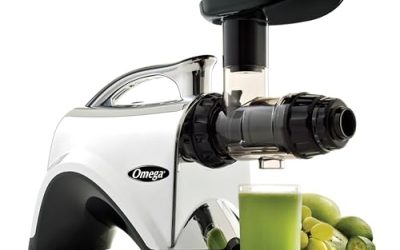
Omega VSJ843QS

The VSJ843QS is the compact classic of this group, and the slowest. Its auger turns at 43 RPM through a 3-stage design that crushes, squeezes and extracts, and the automatic pulp ejection keeps juice flowing without stopping to empty the chamber. The no-drip tap is a small feature with an outsized morning benefit: close it, pour, and rinse the chamber with water before any pulp dries. In silver, it is the pick for a single person or a couple with limited counter space who juice daily in modest quantities.
Specs
- 43 RPM slow masticating press
- 150W motor
- 3-stage auger with automatic pulp ejection
- No-drip juice tap
- Compact vertical design
- Finish: silver (model VSJ843QS)
Best for: Solo juicers and couples with a small counter and a daily glass habit.
Watch out for: The feed chute is narrower than the wide-mouth models above, so apples and beets need cutting into smaller pieces.
ASIN: B00LIAGKSC
Which One Fits Your Situation
You juice for the whole household before school and work
Choose the Kuvings AUTO10 or the Hurom H320. The AUTO10 wins if you want to load 100 oz of produce and leave the machine to it; the H320 wins if you prefer a slightly smaller machine that still swallows whole fruit and rinses quickly. Both remove the standing-and-feeding step that makes weekday juicing collapse after a week.
Your counter is small and the juicer lives out permanently
The Omega VSJ843QS is the easiest to place, with the narrowest presence of the four and a tap that keeps drips off the counter. Measure your cabinet clearance anyway, because even compact vertical juicers stand tall once the hopper is fitted. If it fits, the Omega’s slow, steady press suits a one-glass routine perfectly.
Your morning recipe is mostly greens, celery and carrots
Pick the Kuvings REVO830. The 48mm auto-cut chute is designed exactly for long, fibrous produce, so celery and carrots go in whole instead of being chopped into pieces that tangle in a standard chute. Pair it with the wide 88mm gate for apples and citrus, and the whole recipe avoids the cutting board.
You are upgrading from a centrifugal juicer and hate the noise
Any model here will feel calm by comparison, but the Hurom H320 and Kuvings AUTO10 are the two whose listings lead with quiet motor design. Expect a low hum rather than silence, and expect the press itself to take a few minutes longer than a spinning centrifugal basket. Most people trade that time gladly for a calmer kitchen.
Common Mistakes
- Buying by chute width alone and ignoring cleanup, then abandoning the routine within a month.
- Overloading the hopper with hard produce all at once, which strains the auger and stalls feeding.
- Forgetting to measure under-cabinet height, then having to assemble the juicer on the counter edge daily.
- Leaving pulp in the strainer until evening, when it dries and turns a rinse into a scrubbing session.
- Feeding large seeds and pits, such as peach stones, which the listings warn should be removed first.
Frequently Asked Questions
How long does a vertical masticating juicer take each morning?
For a typical two-glass recipe, expect around five to ten minutes of pressing once produce is loaded, plus a few minutes of prep depending on chute size. Batching models like the AUTO10 cut the active time down because you load once, while narrow-chute models add chopping time before the machine starts.
Are vertical masticating juicers hard to clean?
They are easier than their part count suggests if you rinse immediately. Most parts separate by hand and rinse under the tap; strainers are the one component that benefits from the included brush. Coarse strainers, like those supplied with the Hurom H320, rinse noticeably faster than fine mesh screens.
Can these juicers handle leafy greens and wheatgrass?
Yes, in the amounts a morning recipe usually calls for, especially when greens are rolled or layered between firmer produce so the auger can grip them. The REVO830’s auto-cut chute is particularly suited to celery and leafy bundles. For wheatgrass as the main ingredient in large volumes, a twin gear machine is the more specialised tool.
What size juicer do I need for one person?
A compact model with a modest chamber, such as the Omega VSJ843QS, covers one or two glasses without leftover parts to wash for a full batch. Larger hopper machines only pay off when you regularly juice for three or more people or prep several days of juice in one session.